Otzi the Iceman suffered a serious brain injury before dying
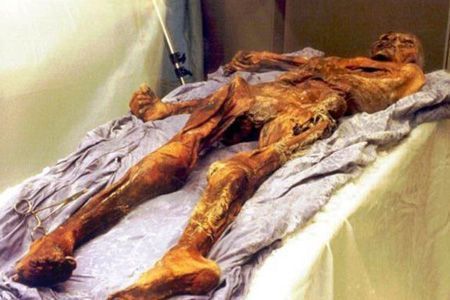
Ötzi the Iceman, Europe's oldest mummy, likely suffered a head injury before he died roughly 5,300 years ago, according to a new protein analysis of his brain tissue.
Ever since a pair of hikers stumbled upon his astonishingly well-preserved frozen body in the Alps in 1991, Ötzi has become one of the most-studied ancient human specimens. His face, last meal, clothing and genome have been reconstructed — all contributing to a picture of Ötzi as a 45-year-old, tattooed agriculturalist who was a native of Central Europe and suffered from heart disease, joint pain, tooth decay and probably Lyme disease before he died.
None of those conditions, however, directly led to his demise. A wound reveals Ötzi was hit in the shoulder with a deadly artery-piercing arrow, and an undigested meal in the Iceman's stomach suggests he was ambushed, researchers say.
A few years ago, a CAT scan showed dark spots at the back of the mummy's cerebrum, indicating Ötzi also suffered a blow to the head that knocked his brain against the back of his skull during the fatal attack.
In the new study, scientists who looked at pinhead-sized samples of brain tissue from the corpse found traces of clotted blood cells, suggesting Ötzi indeed suffered bruising in his brain shortly before his death.
But there's still a piece of the Neolithic murder mystery that remains unsolved: It's unclear whether Ötzi's brain injury was caused by being bashed over the head or by falling after being struck with the arrow, the researchers say.
The study was focused on proteins found in two brain samples from Ötzi, recovered with the help of a computer-controlled endoscope. Of the 502 different proteins identified, 10 were related to blood and coagulation, the researchers said. They also found evidence of an accumulation of proteins related to stress response and wound healing.
Proteins are less susceptible to environmental contamination than DNA, and, in the case of mummies, they can reveal what kinds of cells the body was producing at the time of death.
Andreas Tholey, a scientist at Germany's Kiel University and a researcher on the new Ötzi study, said in a statement,
"DNA is always constant, regardless of from where it originates in the body, whereas proteins provide precise information about what is happening in specific regions within the body." Their research was detailed in the journal Cellular and Molecular Life Sciences.