China's memory chip efforts face stronger headwinds as Micron, Samsung, SK Hynix race ahead on AI
Summary
China’s memory-chip makers are falling further behind global leaders as U.S. export restrictions limit YMTC and CXMT’s ability to advance in 3D NAND and DRAM. Micron, Samsung Electronics and SK Hynix are advancing high-bandwidth memory technologies for generative AI, while Chinese firms remain dependent on foreign suppliers for advanced server memory. The widening gap could hinder China’s development of large AI models.
Key Facts
- Micron announced samples of its HBM3 Gen2 die for generative AI applications, while Samsung Electronics completed development of GDDR7 DRAM and plans to expand high-bandwidth memory in 2024.
- SK Hynix held about 50 percent of the global high-bandwidth memory market and planned to double HBM production in 2024 for AI servers.
- YMTC had about a 3 percent share of China’s NAND flash sales, while CXMT held 21 percent of Chinese DRAM manufacturing capacity, according to TrendForce.
- YMTC’s advanced NAND production has struggled to move beyond 128 layers because U.S. export controls have restricted access to equipment.
- China’s AI companies, including Baidu, Alibaba Group Holding, Tencent Holdings and JD.com, were seeking Nvidia A100 and H100 GPUs amid demand for generative AI models.

The company logo is seen on the Micron Technology offices in Shanghai, China, May 25. Reuters-Yonhap

Beijing's ambitions of joining the world's top memory-chip makers, and replacing imports with local products in the domestic market, look increasingly at risk as the world's leading players adopt cutting-edge technologies while China's ability to catch up is hampered by U.S. sanctions, according to analysts and industry insiders.
This, in turn, could seriously hinder China's ability to develop large artificial intelligence (AI) models when the country is already reliant on U.S. suppliers such as Nvidia for sanctions-compliant versions of graphics processing units, or GPUs, they said.
Not long ago, China was seen as catching up quickly with international suppliers in the field of advanced 3D NAND flash and DRAM memory chips, but the gap could have widened again in the era of ChatGPT as Yangtze Memory Technologies Corporation (YMTC) and ChangXin Memory Technologies (CXMT) are unable to press ahead with catch up efforts due to the U.S. export restrictions.
In comparison, U.S.-based Micron Technology, which is banned by Chinese authorities from selling certain products to some local clients, last month announced samples of its high-bandwidth memory 3 (HBM3) Gen2 die to support generative AI applications. Samsung Electronics said last month it has completed development of GDDR7 DRAM for AI applications, and it will double down on high-bandwidth memory in 2024 to meet growing demand in AI applications. Meanwhile, rival SK Hynix, which tops the global HBM market with a 50 percent market share, is also set to double its HBM production next year for AI servers.
Analysts and industry professionals told the South China Morning Post that Micron, Samsung and SK Hynix remain the default choice for many downstream buyers and that Beijing's restrictions on Micron, which previously had about a 15 percent market share in China's server DRAM market, mostly benefited its two Korean competitors.
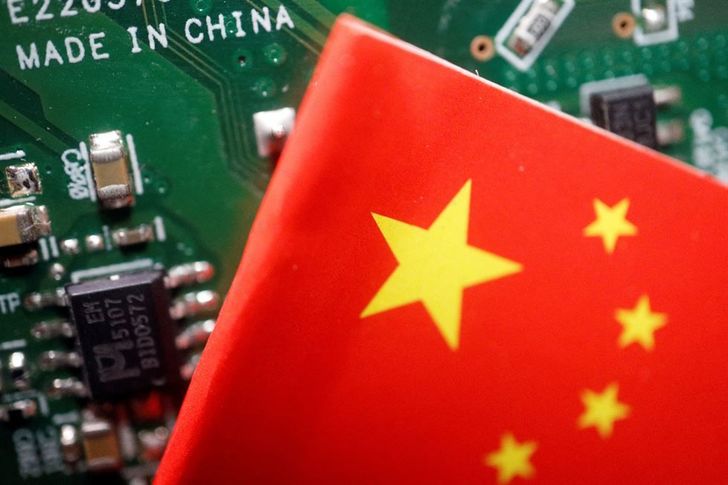
In this illustration picture, a Chinese flag is displayed next to a "Made in China" sign seen on a printed circuit board with semiconductor chips, Feb. 17. Reuters-Yonhap
"The premier choice of replacement for Micron is still Samsung [and] SK Hynix," said an executive at a memory controller producer, who asked not to be named due to the sensitivity of the matter.
China's shortcomings in storage capacity would hinder the country from making the most of its massive data resources in AI development, Ni Guangnan, a Chinese semiconductor expert and an advocate for China's semiconductor self-sufficiency, told the World Semiconductor Conference Expo in Nanjing last month.
Big Tech Chinese firms from Baidu and Post owner Alibaba Group Holding to Tencent Holdings and JD.com are eager to develop generative AI models amid a heated global AI race, creating a black market for Nvidia GPUs such as the A100 and H100. However, Ni said the importance of data storage is often given less attention in China as the primary focus is on computing power.
Top-tier AI server GPUs have set a new industry standard by primarily using high-bandwidth memory, according to a research note by TrendForce. HBM, a type of advanced DRAM optimized for AI innovation, is only manufactured by Micron, Samsung and SK Hynix.
China has kept its cards close to its chest regarding its latest technologies, leaving the outside world to guess how far it is progressing in Beijing's self-sufficiency drive. YMTC, for example, has not updated its website news page since October 2022. The company has resorted to local tool suppliers to keep up with its advanced 3D NAND production as strict U.S. export controls have made it harder to go beyond 128 layers, the Post reported previously.
While these locally-made memory chips are suitable for consumer electronics, they may fall short if used for AI servers. Brady Wang, an associate director with research firm Counterpoint, said China has to buy advanced memory chips from Korean and Japanese suppliers as server memory chips often have a higher requirement than consumer-facing products.
"If [China] insists on using domestic products for security reasons, it would mean compromise on the quality [of servers]," Wang said. He added that it would be hard for YMTC and CXMT to rely purely on the domestic supply chain for their technology development when global peers have access to the best available equipment.
In the China market, YMTC has about a 3 percent share in NAND flash sales, with U.S. sanctions damaging yields on its advanced NAND chips, while CXMT holds a 21 percent share of DRAM manufacturing capacity, the highest among Chinese DRAM makers, according to TrendForce.
However, the Hefei-based company maker, whose best offering is DDR4 DRAM, is still trailing several generations behind its international competitors in terms of technology. (SCMP)
Read the
at SCMP
Explore More
- Q.
- Q.
- Q.