Will EU ask Korea not to cut minimum wage of migrant shipbuilding workers?

Seen is a message that Tom Jenkins, former chair of the European Union's domestic advisory group set up under the Korea-EU FTA, tweeted last Friday. Screenshot from Twitter
By Park Jae-hyuk
A former chair of the European Union's domestic advisory group set up under the Korea-EU FTA raised questions about the legality of a recent request by the Korea Enterprises Federation (KEF) to lower the minimum wage for migrant shipbuilding workers who hold E-7 visas issued to foreigners with special skills.
“Korean employers want cut in the minimum wage for shipbuilding migrant workers. Surely a breach of non-regression commitments in the Korea-EU and indeed the Korea-U.K. FTAs?” Tom Jenkins, who also served as a senior adviser of the European Trade Union Confederation, tweeted last Friday, sharing The Korea Times' article on the business lobby's request.
“I would argue that a cut in the minimum wage amounts to a weakening of labor protections and that, especially as shipbuilding is key Korean export, this would affect trade,” he added on Sunday.
Jenkins also asked the Delegation of the EU to Korea to look into this matter and scrutinize the treatment of migrant workers in Korea.
Under current Korean laws, E-7 visa holders are guaranteed base wages equivalent to 80 percent of the previous year's gross national income (GNI) per capita.
In order to help make foreign labor more affordable for subcontractors of large shipbuilding companies, however, the government took a temporary measure earlier this year, allowing small firms and startups, as well as medium-sized enterprises not located in the Seoul metropolitan area, to pay a minimum of 70 percent of the previous year's GNI per capita to employees holding the E-7 visa.
As the subcontractors cried foul over the fact that foreign workers can still earn more pay than their Korean peers if they work overtime, the KEF demanded the government take more drastic deregulatory measures.
Article 13.7 of the Korea-EU FTA, however, stipulates that a party shall not weaken or reduce the labor protections afforded in its laws.
The Korean Confederation of Trade Unions, one of the country's two largest umbrella labor groups, also denounced the KEF for its request, accusing it of being retrogressive and infringing on human rights.
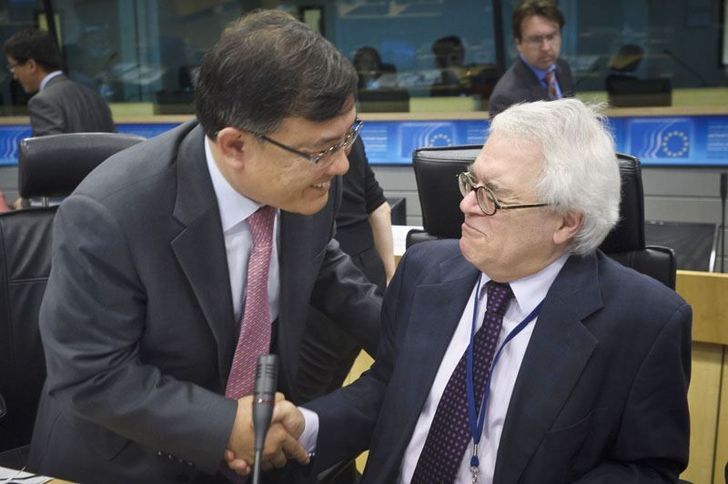
Tom Jenkins, right, then chairman of the European Union's domestic advisory group set up under the Korea-EU FTA, shakes hands with his Korean counterpart, Eom Hyeon-taek, then member of the Economic and Social Development Commission, during the first Civil Society Forum in Brussels in this 2012 file photo. Courtesy of Economic, Social & Labor Council
The KEF said it is reviewing whether its recent request goes against the Korea-EU FTA.
“Even if E-7 visa holders are guaranteed base wages equivalent to 60 percent of the previous year's GNI per capita, their salaries are still higher than the statutory minimum wage,” said the head of the business lobby's regulatory reform team. “We thought that the government should reform the dual regulation on the minimum wage for E-7 visa holders.”
There is also speculation that this issue can be discussed during the forthcoming Korea-EU joint civil society forum. According to Article 13.13 of the Korea-EU FTA, members of domestic advisory groups of each side shall meet at the forum once a year, unless otherwise agreed by the parties.