ANALYSIS Businesses push to be self-sufficient amid global supply chain disruptions

Samsung Electronics is finalizing a $17-billion plan for a new plant in the United States, in addition to the one already in operation in Austin, Texas, as seen in this undated photo. Korea Times file
Expanded gov't support crucial for companies to survive in changing international order
By Yi Whan-woo
Manufacturing businesses seem to be trying to become as self-sufficient as possible, from the sourcing of raw materials to the rolling off of finished goods, as global supply chains continue to face ongoing disruptions.
Globalized supply chains utilized by the companies have been exposed to multiple risks, including the COVID-19 pandemic, the U.S.'s moves to decouple China from them, the energy crisis in China, and trade being weaponized amid diplomatic conflicts.
Among the affected Korean industries are the semiconductor, large battery and automobile industries. To minimize risks, they have been reshaping their overseas businesses, such as by making major investments to obtain raw materials directly, and by setting up or expanding new production lines.
“A singular focus on operating margins and asset efficiency has resulted in sometimes brittle, lean, and offshored supply chains,” the U.S. think tank, the Brookings Institution, said in a report titled, “How to build more secure, resilient, next-gen U.S. supply chains.”
The report noted that leading multinationals have long recognized that managing supply chain risks was necessary to sustain competitiveness.
“Assuming a longer-term perspective may make investing in resilience a better value proposition, although a variety of issues … could serve as barriers to such a perspective,” it added.
In the semiconductor industry, Samsung Electronics plans to invest 171 trillion won ($146.5 billion) in the logic chip and foundry businesses by 2030.
The investment follows its rivals' moves to increase production capacity to meet the soaring demand for semiconductors.
The Korean tech giant is finalizing a $17 billion investsment plan for a new foundry plant in the U.S, while constructing a new chip fabrication plant in Pyeongtaek, Gyeonggi Province, by the second half of 2022.
The Pyeongtaek plant will produce seventh generation 14-nanometer DRAM chips and 5-nanometer logic semiconductors using extreme ultraviolet lithography technology.
SK hynix, Korea's second-largest chipmaker after Samsung Electronics, is looking to double its foundry capacity through domestic facility expansion, and mergers and acquisitions.
The strategy includes investment in the 8-inch foundry business to tackle global chip shortages, while helping the overseas expansion of domestic fabless companies.
SK hynix also plans to build four additional chip fabrication factories in a semiconductor cluster in Yongin, Gyeonggi Province. The construction of its first new fab is expected to start in 2024, and mass production from that facility could be possible as early as 2025.
In the U.S., SK hynix plans to spend 1 trillion won on a research and development center in Silicon Valley.
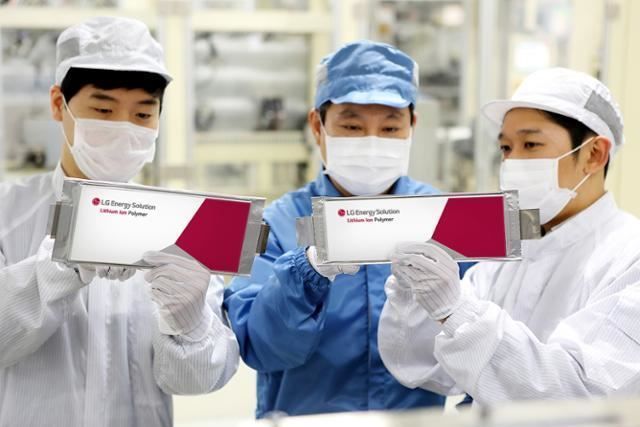
LG Energy Solution workers examine newly-manufactured batteries at the firm's Ochang plant in Cheongju, North Chungcheong Province in this undated photo. Korea Times file
In the battery sector, LG Energy Solution (LGES) plans to invest more than $4.5 billion in its U.S. battery production business over the next four years.
It signed a six-year deal with Canada's lithium exploration and development company, Sigma Lithium Corp., for the supply of lithium to better cope with the soaring demand in the white metal used in electric vehicle (EV) batteries.
LGES's offtake agreement for obtaining battery-grade lithium, concentrated on a “take or pay” basis, will increase from 60,000 tons per year in 2023, to 100,000 tons per year from 2024 to 2027.
It also acquired a 4.8 percent stake in China's Greatpower Nickel and Cobalt Materials for 35 billion won, securing a stable supply of nickel, a key battery material.
Rising cost of materials
Greatpower Nickel and Cobalt Materials has been building a plant in China for nickel sulfate, with construction slated for completion in 2023.
The two sides signed a six-year contract, with LGES to purchase about 20,000 metric tons of nickel beginning from 2023 ― enough to supply batteries to about 370,000 electric vehicles that can each travel more than 500 kilometers on a single charge.
SK Innovation (SKI) signed an agreement to buy cobalt from Switzerland-based trading firm Glencore, as part of its efforts to obtain a stable supply of this key EV component.
The contract runs from 2020 through to 2025, with total purchases of about 30,000 metric tons of cobalt, enough to supply batteries for 3 million EVs.
In China, the battery arm of SK Group agreed to a joint venture with EVE Energy and BTR for the direct production of material for cathodes, a key EV battery component.
SKI will invest 25 percent in the joint venture, while EVE Energy and BTR will hold 24 percent and 51 percent stakes in the proposed entity, respectively.
The joint venture plant will have an annual output of 50,000 tons of material ― sufficient to produce cathodes that can help deliver 33 gigawatt-hours of battery capacity, capable of running about 470,000 EVs.
Samsung SDI signed a memorandum of understanding with the Australian smelting company, QPM, with the Australian side to supply 6,000 tons of nickel per year to the Korean company for three to five years to come.
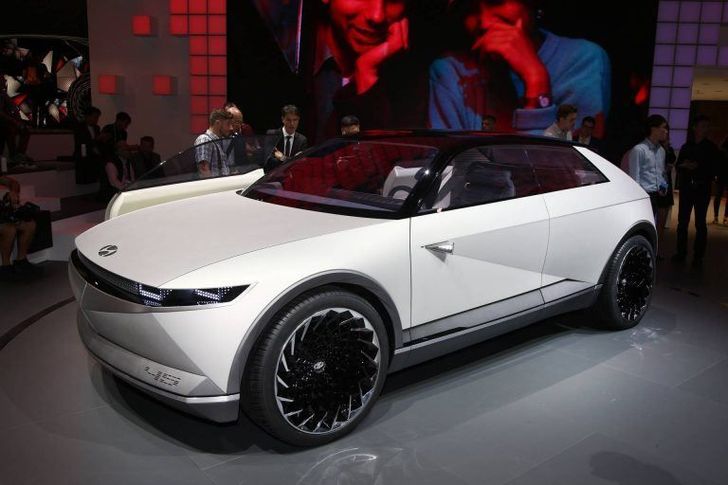
A concept electric vehicle to be manufactured at Hyundai Motor's EV plant in Indonesia / Korea Times file
In the automobile sector, firms are boosting their spending on electric and autonomous vehicles amid mounting pressure from governments and investors to reduce carbon emissions.
Accordingly, Hyundai Motor Group is partnering with Indonesia for the creation of an EV ecosystem in the Southeast Asian country.
The conglomerate's flagship affiliate, Hyundai Motor, is also about to complete the construction of a $1.55-billion EV plant in the Deltamas Industrial Complex near Jakarta.
Hyundai Motor also signed a joint venture project with LG Energy Solution to build a $1.1-billion EV battery cell in Karawang New Industry, near Jakarta as well.
On the government level, tax incentives and state subsidies are being planned for semiconductor companies to spend a combined 510 trillion won by 2030.
The government has also come up with new regulations committing overseas diplomatic missions to support Korean businesses.
One new rule outlines specific principles and procedures that commit the diplomatic missions to make constant efforts to foster a more favorable environment for companies striving to get new footholds or strengthen existing ones in overseas markets.
Kim Tae-gi, a Dankook University economics professor, said the government support should be expanded, saying, “The global supply chain disruptions are more than individual companies can handle.”
Meanwhile, the Brookings Institution outlined the elements that are crucial to building a resilient supply chain.
These elements are: a supply chain capable of rapid detection, response, and recovery from changed conditions; end-to-end, data-driven, supply chain control; redundancies, including emergency stockpiles, safety stocks and diversified sourcing from offshored, nearshored, and/or reshored suppliers; collaboration among private and public supply chain stakeholders; and effective demand planning processes.