LG to focus on future mobility after exiting phone biz

LG Electronics' smartphones are displayed at the company's store in Seoul, Monday. Yonhap
Korean tech giant to quit making phones from July 31
By Baek Byung-yeul
LG Electronics announced Monday that it has decided to end its money-losing smartphone business and realign its business structure with a focus on new businesses, such as future mobility.
The decision came at a board meeting of the Korean electronics giant, and following it the company will end its mobile phone business from July 31.
LG described the decision as a strategic exit as the company needed to reallocate resources efficiently to promising areas such as electric vehicle (EV) components, connected devices, robotics, artificial intelligence and business-to-business platforms.
Among the new business areas mentioned, the company is expected to concentrate on EV components given it has been expanding its presence gradually in emerging sectors such as EV and vehicle components. Last December, LG announced the establishment of a joint venture with automotive parts maker Magna International to manufacture electric motors, inverters and onboard chargers used in EVs.
“LG Electronics has not been able to produce meaningful results due to its insufficient response time when the premium smartphone market is dominated by two companies and the price competition in the budget smartphone market has intensified,” the company said in a statement.
“Under these circumstances, LG will focus its capabilities on core business that can streamline internal resources and secure competitive advantages through a choice and concentration strategy. At the same time, the company plans to improve its business structure by accelerating preparations for new business sectors,” LG added.
After suffering operating losses since 2015, LG recently attempted to sell its mobile communications unit, which oversees the smartphone business. The company was in negotiations with various interested buyers, including Vietnam's Vingroup, but failed to reach an agreement with any of them.
With the exit decision, LG noted that it will reassign around 3,700 employees currently working in the mobile communications division.
Most of the staff are expected to be relocated to the new EV component joint venture established between LG and Magna, which will be officially launched in July. Also, smartphone production lines overseas such as in Vietnam and Brazil will be realigned to manufacture home appliances. LG halted its phone production line in Korea in 2019.
“Moving forward, LG will continue to leverage its mobile expertise and develop mobility-related technologies such as 6G to help further strengthen competitiveness in other business areas. Core technologies developed during the two decades of LG's mobile business operations will also be retained and applied to existing and future products,” the company said.
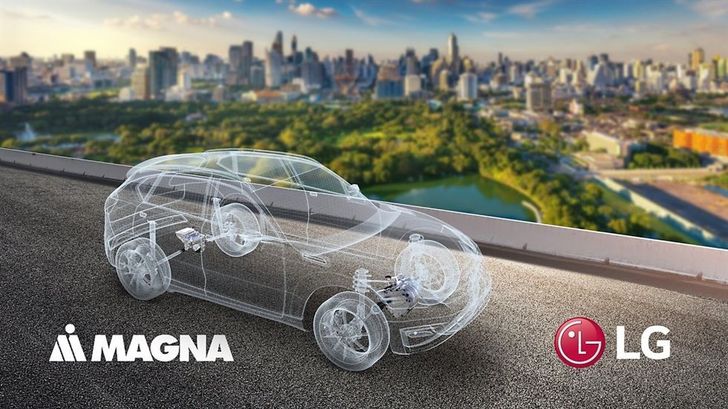
This car prototype illustration shows the LG and Magna logos of each company for their joint venture. Courtesy of LG Electronics
For LG smartphone users, the company will maintain its after-sales service. The company elaborated that it will continue providing repair services and supplying related components in accordance with the standards of each country.
“After closing the business, we will continue our after-sales service so that customers suffer no inconvenience,” the company said. According to the Fair Trade Commission's consumer dispute resolution standards in Korea, the warranty period for smartphones is two years and the period for components is four years.
The Ministry of Science and ICT said it expects LG will comply with the standards of the Fair Trade Commission. “We will discuss the issue with LG and mobile carriers to see that consumer protection measures are sufficiently maintained,” a ministry official said.