Korea leading global smart revolution

Engineers of mobile carrier KT inspect the Internet connection of a building in Gwanghwamun, Seoul. / Courtesy of KT
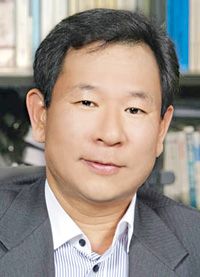
Yoo Tae-yol
By Yoo Tae-yol
At the end of September, United States Federal Communications Commission (FCC) Chairman Julius Genachowski announced the regulator’s policy vision and the performance of the broadband economy, and he confidently expressed that his country finally gained global information technology leadership. As supporting grounds, he mentioned that more than 80 percent of the total households have access to 100 megabyte high-speed fixed broadband, 80 percent of the smartphones operating systems (OS) come from his country and that it has the largest number of long-term evolution (LTE) subscribers. In addition, he showed the future plan of the FCC to upgrade networks to maintain its global information technology leadership and to create more jobs and promote economic growth.
Many countries, including the United States, are trying to lead the global information technology industry because of the emerging new mobile-based “smart revolution”. Smart revolution means that the world is connected to the mobile network and smart devices of which have combined to form a new network, production, distribution, and consumption behavior in every industry across the globe. Thanks to this trend, goods that were hitherto traded offline are now produced and consumed through the network. A new virtual goods market (apps, ebooks, music, movies, games ― all digital products transacted over the network) has emerged.
These items have no borders, no tariffs, no transportation costs, and can be traded anytime, anywhere so long as there is access to internet. Virtual goods are therefore has in many ways ushered in a vigorous global market.
The record set by Psy’s “Gangnam Style” with over 580 million views, is highly unprecedented in the history of YouTube. His video has practically been viewed in nearly every country on earth. The fact that it remained No. 1 on the iTunes music charts across 18 countries owes much to the characteristics of virtual goods. This market is expected to grow further and is projected to reach 160 billion dollars in 2015.
Since this new market has a low-failure risk and a relatively smaller entry cost, the business opportunities are clearly endless. Korea being a nation with highly educated and hi-tech savvy young people is poised to make great gains in this area. The sheer thought of having our young people succeed in even claiming 10% of the total market share of the virtual market is enough to bring smiles to my face.
The smart revolution is also creating jobs, but more importantly acting as the key to the solution of various problems facing our society. Smart-work involving the use of technology such as video conferencing and teleworking, can reduce carbon dioxide emissions by decreasing commuting distance, speaks to the inherent promise of this trend. It could also help increase the country’s low birthrate and reduce families’ childcare burden. Taking advantage of various health-related smartphone applications will help us cope with medical problems caused by aging.
Ultimately, which country has what it takes to lead this revolution? As the FCC chairman said earlier, the United States? With due respect to him, I believe that Korea surpasses the United States in many ways and has the possibility to become the leader. At the end of 2009, approximately 50,000, people used smartphones in Korea which was the lowest among OECD countries. However, in just two and a half years, the figure has reached over 30 million, climbed up the rankings and has a 60 percent penetration rate of the total Korean population. In LTE, the nation built the world’s first national coverage for the service, with the number of subscribers second behind the United States. In proportion of subscribers, it is four times more than America. Korea has become an LTE powerhouse. The fact that the speed and quality of our fixed networks are the world’s best is well known.
According to the OECD, the nation has an average connection speed of 16.6 megabytes per second, overtaking Japan’s 8 megabytes and the United States’ 4.6, securing our unique position. Domestic mobile phone manufacturers were slow in starting to make smartphones, but from this year, combined together they topped the world smartphone market in share.
To continue leading, as well as for the companies to make innovations, the role of the government to support them is also very important. However, the current reality of the Korean government does not suggest there is such a commitment. Not only are excessive regulations hindering them, one-sided rate reductions in telecom services instigated by populism by politicians every election season as well as governance issues making it difficult to promote long-term promotion policies should be addressed urgently. Due to problems with the government, Korea’s information technology competitiveness index, which was the world’s best, has been falling continuously. Now is the time when the government should be smart.
Heavy and chemical industries such as steel led us in the 1970s, automobiles in the 1980s and the information technology industry since the 1990s. However, due to the concentration of hardware like mobile phones and semiconductors, the information technology industry caused biased job creation and growth limitation as the main industry, and continues to be a controversial situation. A global smart revolution will mitigate this by providing chances for software jobs to grow alongside the old powerhouses. The new revolution will take the information technology industry one step further. Moreover, that will create new jobs and solve various social problems so that we will be able to seize an important opportunity to let our economy grow significantly.
Yoo Tae-yol is executive vice president of KT Economics & Management Research Lab