Delivery Hero decides to sell Korean unit

The logo of Delivery Hero
By Nam Hyun-woo
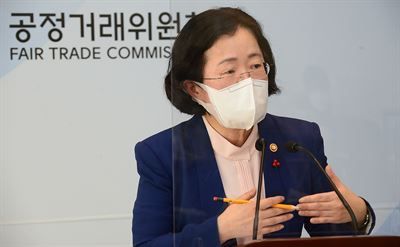
Fair Trade Commission (FTC) Chairwoman Joh Sung-wook speaks during a press conference on the conditional approval of Delivery Hero's acquisition of Woowa Brothers at the antitrust agency's headquarters in Sejong, Monday. Courtesy of FTC
Delivery Hero (DH), a German food delivery service firm, said Monday it will accept the Fair Trade Commission's (FTC) conditional approval for its acquisition of Korea's top food delivery app operator, Woowa Brothers which runs Baedal Minjok.
The FTC ordered DH to sell its Korean unit running the country's No. 2 food delivery app, Yogiyo, in order to but Woowa, as the antitrust agency feared the acquisition would “seriously harm” fair competition in the domestic food delivery market.
While Delivery Hero Korea (DHK) is running Yogiyo, the headquarters separately controls the Nos. 3 and 4 delivery app here ― Baedaltong and Foodfly. If DH were to control all of them, the company's market share here is anticipated to reach over 99 percent.
In a press release, DH said it “will accept the conditional regulatory approval of its strategic partnership with Woowa Brothers,” adding it “expects to receive final written approval and closing to occur in the first quarter of 2021.”
“We are deeply saddened by the required condition to divest DH's subsidiary DHK,” Delivery Hero CEO Niklas Ostberg said. “I want to personally express our gratitude to the team for all these years of collaboration and quest to create an amazing customer experience. We wish DHK the best for the future, and will work hard to ensure that this transition is as smooth as possible for all impacted employees.”
The statement was a response to the FTC's conditional approval of the planned acquisition of an 88 percent stake in Woowa Brothers, as long as it sold DHK within six months after receiving the written approval.
It also allowed the possibility of a six month extension _ as requested by DH _ if the German firm is unable to offload DHK due to “inevitable circumstances.” Along with the divestment order, the FTC demanded DH run its other food delivery apps independently and to not change delivery rates until the sale of DHK is closed.
“The FTC sees serious possibilities of this acquisition harming the domestic delivery app market,” FTC Chairwoman Joh Sung-wook said in a press conference. “Based on the transaction amount, the combined market share of food delivery apps that DH will control reached 99.2 percent as of last year, and this enables the presumption that the deal will harm fair market competition.”
Last year, Baedal Minjok's market share in terms of transaction amounts reached 78 percent, followed by DHK's Yogiyo with 19.6 percent, Baedaltong with 1.3 percent and Foodfly with 0.3 percent.
DH signed the acquisition deal Dec. 13 last year, and filed for the FTC's regulatory review on the deal Dec. 30 that year. During the one-year review, the recent growth of Coupang Eats in Korea was mentioned as a decisive factor in determining whether DH will have a monopolistic status, but the FTC ignored this.
“Though Coupang Eats is showing rapid growth in Seoul and the adjacent areas, it is running a high-cost service of one-order-one-delivery, and there is not enough evidence to suggest this type of service could expand across the country,” Joh said. Coupang Eats' market share was estimated at below 0.8 percent in 2019 but it grew to nearly 5 percent as of July this year, according to the FTC.
Another key reason for the FTC's decision was the possibility of DH potential hiking delivery rates by exploiting its monopolistic status.
Joh said Woowa Brothers' delivery rate adjusting system change in April this year resulted in actual hikes in delivery fees, and the acquisition would allow a greater chance of a rate hike.
In its analysis, the FTC said Baedal Minjok and Yogiyo both issued a smaller number of discount coupons to consumers and restaurants in regions where their market shares were higher than their rivals. Given the acquisition will ease delivery apps competition to secure more serviced restaurants, a potential rate hike is anticipated, the agency said.
The FTC also anticipated less than 1 percent of restaurants will leave Baedal Minjok or Yogiyo even if DH raises delivery fees.
As DH has decided to accept the FTC's condition for approval, Yogiyo's sale is expected to create a stir in the domestic market. DHK is currently valued at around 2.4 trillion won ($2.2 billion), meaning that any buyer must have abundant resources. Big name firms such as Naver, Kakao and Coupang are already being mentioned as potential buyers, although the companies say they are not considering any acquisitions at this time.