COVID-19 to lead to protectionism in global supply chain
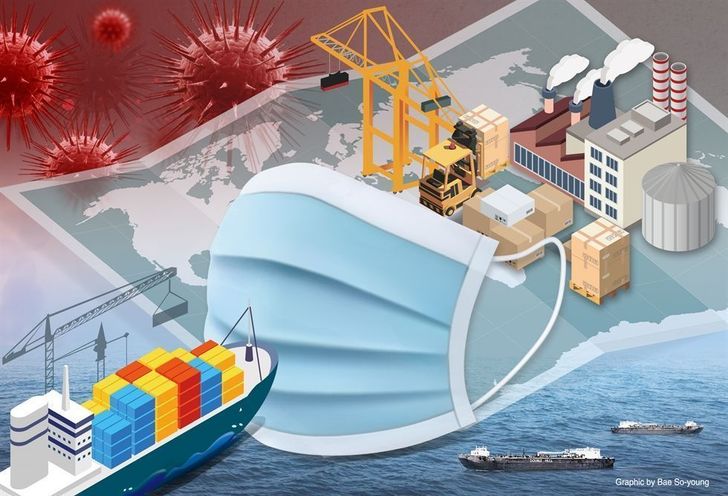
The unprecedented coronavirus pandemic, which broke out in late December 2019 and has now engulfed the world, portends to reshape our lives, and the world order as we know it. This is the sixth of a series to cast light on the changes that might lie ahead. ― ED.
By Nam Hyun-woo
The world is busy anticipating what the global economy will look like after the COVID-19 pandemic ends. Experts say the world will experience fundamental changes in trading arrangements, with a reduced dependence on global supply chains due to protectionism and reshoring.
“The rise of protectionism and the weakening of the global supply chain will be expedited after COVID-19 and become the new paradigm of global trade,” said Trade Minister Yoo Myung-hee. “This will lead Korea to be exposed to greater risk, given its export-driven industrial structure.”
Businesses are expressing similar views. Korea Enterprises Federation (KEF) Chairman Sohn Kyung-shik warned that “protectionist barriers will rise among economies.”
Korea was one of the first countries to experience the economic fallout of COVID-19. In February, Hyundai Motor and Kia Motors shut down their plants temporarily due to problems in getting supplies of wiring harnesses from China after it went into lockdown. The two carmakers have since been forced to cut production due to reduced demand in major export markets, such the U.S. and Europe, which are also under lockdown.
These developments have raised doubts about relying on global supply chains to cut labor and other costs.
“In the past, companies had a strategy of offshoring manufacturing to countries with cheaper costs or big markets, thus making China the world's greatest offshoring magnet,” said Mun Byung-ki, a senior researcher at the Institute for International Trade at the Korea International Trade Association.
“However, as competition between major economic powers increased in a period of low growth, some economies veered into protectionism. The COVID-19 outbreak has highlighted the critical risks and weaknesses of conventional global supply chains,” he said. “For companies, minimizing risks and uncertainties is a top priority in their business strategies. The pandemic is a loud wake-up call to alert them to the lurking risks of traditional supply chains, and leading them to consider reshoring.”
Another industry officials also told The Korea Times that companies are starting to reexamine their conventional overseas strategies in the wake of the coronavirus pandemic. “Labor cost advantages from offshoring have weakened a lot in the past several years,” one executive told The Korea Times. “A growing number of companies are now putting more emphasis on market conditions, growth potential, risks and resilience when they decide on overseas investments.”
A growing number of countries, particularly the U.S., are encouraging companies to come back home and strengthen their domestic supply chains. Korea is also promoting reshoring. On April 27, the government and manufacturing business associations jointly launched a taskforce supporting “U-turn companies,” meaning companies returning to Korea.
In supporting the program, the Ministry of Trade, Industry and Energy said “the importance of reshoring is growing amid the increased need to stabilize the supply chain of Korea's backbone industries after COVID-19.”
The government in February also announced new policies to help reshoring companies, including tax cuts and financial aid worth 4.5 trillion won.
Following the announcement, LG Electronics said it would support suppliers that bring their plants back to Korea. One of the them, Dong Gu Enterprise, decided to join the campaign.
Multilateral partnerships
Experts said partnerships between companies or countries will be one of the ways for businesses to deal with the new trading order.
“With global supply chains getting weaker, companies and countries will compete more fiercely for key raw materials and core technologies,” Mun said. “To overcome this, companies with common ground can form partnerships. However, this will be available only in growing sectors, because partnerships can exist only when there is growth. Thus, the first step to survive in the new trade order is finding new growth drivers.”
Trade Minister Yoo also said the trade strategies in the post-coronavirus era should be focused on multilateral trade networks among companies, and businesses should be prepared to restructure global supply chains to obtain greater stability and resilience rather than efficiency.