KEPCO set to charge more for electricity
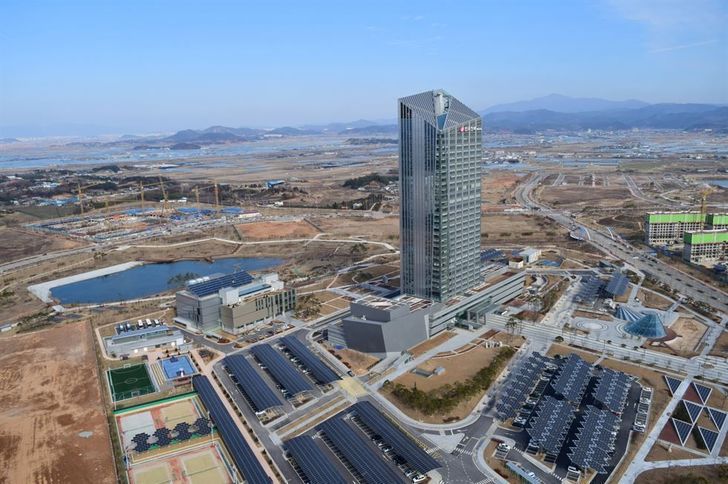
Korea Electric Power Corp. (KEPCO) headquarters in Naju, South Jeolla Province / Courtesy of KEPCO
By Nam Hyun-woo

Korea Electric Power Corp. CEO Kim Jong-kap
Korea Electric Power Corp. (KEPCO) is poised to raise electricity rates as it continues to lose money amid the Moon Jae-in government's drive to phase out nuclear power and expand the use of expensive renewable energy, according to industry analysts Tuesday.
The state-run power company published a report stressing Korea's heavier reliance on renewable energy sources has led to higher costs of generating electricity, which the analysts said is a bid to assert the necessity to raise utility rates and gauge public opinion over potential price hikes.
According to KEPCO, it logged 629.9 billion won ($529.6 million) in operating losses in the first quarter of this year. It was more than twice the market expectation of 300 billion won and far greater than the 127.6 billion won operating loss KEPCO posted in the first quarter of last year.
Since the fourth quarter of 2017, when the Moon government began transitioning to a post-nuclear policy, KEPCO has been posting operating losses every quarter, except for the third quarter of last year, when the scorching weather exponentially increased the country's power use.
The poor numbers came after KEPCO Management Research Institute's May 8 report. In the report, the institute stated “a higher reliance on gas and other renewable energy sources leads to higher electricity rates,” citing major developed countries' electricity billing systems.
The report said Korea's average electricity price was 125.1 won per 1 kilowatt-hour in 2017, which was 47 percent of the average price of 263 won per 1 kilowatt-hour in Germany, France, Spain, the U.K., Italy, the U.S. and Japan in the same year.
The report continued that those countries have a high reliance on renewable energy, with 32.6 percent of Germany's electricity coming from renewable sources. Spain and Italy have a 39.7 percent and 39 percent reliance, respectively.
Over the report, experts said KEPCO is trying to assert the necessity of a utility rate hike and checking public opinion before deciding whether they want to join the government's campaign for renewable energy.
“There seems to be a strong hint that the company has no option but to raise the utility rate if the country continues to phase out nuclear energy and expand the use of renewable energy,” said Jeong Yong-hoon, a professor at the Korea Advanced Institute of Science and Technology.
“Generally speaking, the cost of generating power from nuclear reactors stands at 60 won per 1 kilowatt-hour, while that of solar power is 180 won. An expansion of renewable energy is bound to bring a rise in power generation cost even if the country maintains nuclear power.”
According to Jeong, KEPCO is expected to raise electricity rates for households, because the country's industrial electricity rate is already at the same level of household rates following sharp hikes over the past decade.
According to KEPCO, the average industrial electricity rate was 106.46 won per kilowatt-hour, which is 0.4 won lower than 106.87 for household electricity. This is because KEPCO has been lowering household utility rate, while raising that of industrial electricity.
“In principle, Industrial electricity is cheaper than household electricity because the former requires less costs for transformation,” Jeong said. “Since further hikes in industrial electricity will deal a critical blow to already suffering manufacturers and factories, there seems to be no other choice for KEPCO to raise household utility rate, but this will be faced with strong public opposition too.”