Samsung Electronics suffers 60% fall in profit in Q1
By Baek Byung-yeul
Samsung Electronics saw a sharp drop in its sales and operating profit in the first quarter of 2019 due to falling memory chip prices and weak display panel demand, the firm said Friday.
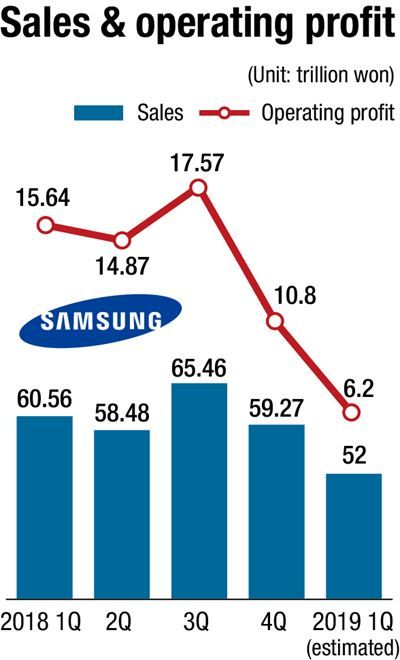
In its preliminary estimate, Korea's tech giant said it posted an operating profit of 6.2 trillion won ($5.46 billion) in the first three months, a 60.36 percent drop from last year's first quarter.
This is the lowest operating profit since the firm posted 5.2 trillion won in the third quarter of 2016.
Sales stood at 52 trillion won ($45.8 billion), a 14.13 percent decrease year-on-year.
With regards to operating profit margin, a measure of a firm's operational efficiency, the figure fell to 11.9 percent, the lowest since the third quarter of 2016 when it hit 10.9 percent.
The figures provided by Samsung are significantly below the market consensus. Analysts estimated the firm would log an operating profit of 6.7 trillion won on sales of 55.8 trillion won.
Thanks to explosive memory chip demand, mainly driven by servers for data centers, Samsung posted record earnings in 2018 with sales of 243.77 trillion won and an operating profit of 58.89 trillion won.
However, the firm made a rare announcement earlier that its first quarter performance would be weaker than the market consensus due to worsening business conditions in memory chips and displays.
“We expect weak memory chip demand as the first quarter is the traditional off-season for the business. Also memory chip prices have plummeted more than we projected,” the firm said in a report to the Financial Supervisory Service.
The company said its display business was also struggling with price cuts due to a supply glut of LCD panels from Chinese makers.
During a share holders' meeting on March 20, Kim Ki-nam, vice chairman and head of the firm's device business unit that supervises the memory chip business, said Samsung was “expected to have a difficult year as the smartphone market, which has driven demand for semiconductors and parts, is slowing down, and companies have reduced their investment in data centers.”
But Kim added the firm is trying to find a breakthrough in other sectors such as cars and businesses related to 5G networks, which have seen an increase in demand for semiconductors.
The firm's IT & mobile communications division is expected to post brisk results compared to the last quarter of 2018 thanks to a positive market reaction to the firm's latest Galaxy S10 premium smartphone.
Despite its lower-than-predicted performance in the first three months of 2019, an analyst said the firm will recover by reducing its memory chip supply.
“I think the key is a second half recovery as customer inventory gets normalized and seasonality turns more favorable,” Gloria Tsuen, vice president and senior credit officer at Moody's Investors Service, said. “Also important is the industry response to the current market weakness ― for instance, Micron has already said it will reduce some supply so if the other companies like Samsung and SK hynix do the same. That will also help memory chip pricing in the second half.”
“Finally I would just note the very strong financial buffers Samsung has that will help them get through this industry down cycle,” the analyst added.