Korea urged to do more for robotics industry

Seen is Yujin Robot's booth installed at the Consumer Electronics Show held in Las Vegas from Jan. 8 to 11. / Courtesy of Yujin Robot
Yujin Robot CEO says industry faces China challenge
By Baek Byung-yeul

Yujin Robot Chairman and CEO Shin Kyung-chul / Courtesy of Yujin Robot
The government should introduce a wider range of policies to support the robotics industry; otherwise, local players will fall behind Chinese and other competitors in the global market, according to the head of local robotics firm Yujin Robot.
“With more people using robots, the government is expanding its efforts to foster the robotics industry. To make it happen, creating an environment where robots can be easily utilized is essential,” Shin Kyung-chul, chairman and CEO of Yujin Robot, said in a recent interview with The Korea Times.
“When the government is setting up a new plan to support the industry, it tries to refer to cases in other countries. But it is important to take the initiative in robotics. Launching a test field so that companies can test their robots in various environments such as homes, buildings, streets and even cities,” he said.
Shin, who also serves as vice chairman of the Korea Association of Robot Industries (KAR), added that offering funding or tax benefits to companies that are in the robotics business could be other ways to nurture the industry.
China emerges as new robotics powerhouse
Widely known for its robot vacuum brand iClebo, Yujin Robot took part in the Consumer Electronics Show (CES) in Las Vegas from Jan. 8 to 11 to show off its cutting-edge robot technologies and products.
At the world's largest tech fair, featuring about 4,500 companies from 155 nations, Shin said he could witness how China has grown into a powerhouse in the robotics industry.
“China is the country that business officials in the robotics industry need to keep their eyes on. Though the country entered the robotics business late, Chinese firms have been accelerating their product development because they have the world's largest market for robots,” the chairman said.
Compared to the Chinese firms, Korean firms are relatively slow at commercializing products because of slow payback periods, Shin said.
“Backed by the huge domestic market, Chinese firms can achieve a fast payback and the reduced payback periods accelerate them to create a virtuous circulation in the industry. They can hire more people, produce more samples and then commercialize their products much faster than Korean companies.”
China's strength in the robotics industry can also be seen from the Chinese government's top-down approach to the sector, he said.
“Even though robot products are not perfect, domestic firms purchase those products as the Chinese government tells them to do so. This also boosts market capacity,” Shin said.
“For example, I saw a serving robot for restaurant purposes made by a Chinese firm at the CES. From my point of view, the company needs more time to develop its robot, but it said the restaurant-serving robots are already commercialized in China.”
Not only robotics firms from the United States, Japan and China but also big companies in Korea showed off their products and shared visions during the CES fair.
Samsung Electronics came up with its new robotics platform Samsung Bot. LG Electronics announced an agreement with internet firm Naver to cooperate for joint robot development.
As an industry expert, Shin said it is a welcoming move as the efforts of big companies can help grow the overall industry pie.
“The large companies are taking the robotics business as their future growth engines. What we need to do is focus on what we have done so far. As there are so many applications for robots, we are taking a different path from them,” he said.
'Worker shortage, brain drain need to be solved'
Shin also pointed out small- and medium-sized enterprises (SMEs) in the robotics industry here are suffering from a worker shortage and a brain drain.
“Korea has one of the most advanced robotics industries along with the U.S., Japan, Europe ― especially France and Germany ― and China. However compared to the other four that I mentioned, Korea's robot technology is less advanced,” the chairman said, calling on the government to develop plans to foster skilled personnel.
“With the rise of artificial intelligence and internet of things (IoT) technology, key sectors in the Fourth Industrial Revolution, many SMEs are short of talented individuals in control and software engineering. This is because qualified individuals in these sectors receive attractive offers from big companies,” Shin said.
“In response, Yujin Robot had to come up with the best alternative plan ― nurturing talented individuals through our training programs. But what is worse is some of them who get trained here move to another firm who pays more than us.
“It would be helpful if the government can set up support policies that can help SMEs secure more workers with the right skillset,” he said.
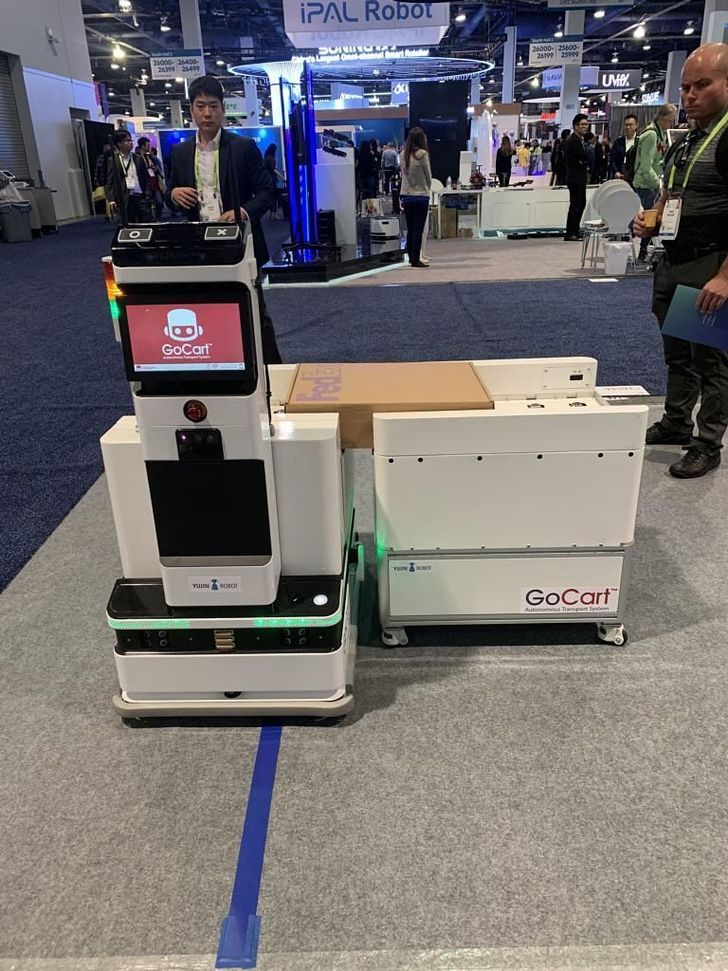
Yujin Robot's GoCart logistics robot is displayed at the Consumer Electronics Show in Las Vegas from Jan. 8 to 11. / Courtesy of Yujin Robot
Established in 1988, Yujin Robot has established itself as one the country's representative robotics companies. It has been selling various kinds of robots including its signature iClebo robot vacuum cleaners, logistic robots, service robots, factory automation systems and military robots.
Yujin Robot clocked sales of 64.95 billion won ($57.58 million) in 2017. Though it hasn't filed its 2018 earnings report yet, Shin assumed the figure will be up 30 percent thanks to robust sales of vacuum cleaners. “In 2018, our sales were buoyed by robot vacuums, of which we sold over 100,000 in both domestic and overseas markets,” he explained.
Speaking of the firm's 2019 goals, Shin said the firm is expected to generate 15 percent more in revenue than 2018 as the firm will launch its new logistics robot brand GoCart.
“The GoCart robot can drive itself to load and unload automatically. It can be widely used in many situations such as factory, hospital, hotels and even restaurants. At first, we will launch the GoCart 120 with a payload of 120 kilograms but will continue to diversify our products lineup by launching GoCart 60 and 500,” Shin said.
It has been a year since Yujin Robot began operating its business from its new headquarters in Songdo, Incheon, 40 kilometers west of Seoul.
While Yujin Robot had operated its business units at different spots, the firm decided to integrate its operations in one place in a bid to enhance operational efficiency.
When asked when we will be able to see robots like “Astro Boy,” a robot character created by late Japanese cartoonist Osamu Tezuka, Shin laughingly made the prediction that “it will be hard for private firms to come up with a humanoid robot in the near future because there is no commercial demand for it.”