Four powerful forces reshaping Asia
.jpg?w=728)
Korea urged to jump on ‘driverless car’ wave
By Kim Jae-kyoung
This is the first of a five-part series to examine major forces or developments that will reshape our world over the coming decades. The Korea Times will look into five key areas ― the global economy, banking, information technology, automobiles, and energy ― in cooperation with global consulting firm McKinsey & Company. ― ED
SINGAPORE ― Japanese electronics giant Sony, which used to reign supreme in the global technology industry, has lost its crown over the past years and is now trying to catch up with market leaders, such as Apple and Samsung Electronics.
There can be many reasons why Sony is struggling but the key culprit might be that it fixated on hardware breakthroughs and failed to adapt to technology disruptions, such as the smartphone wave.
The case of Sony well epitomizes the nature of the current technology market. If you miss a market wave and fail to reset your business, you won’t be able to stay on top. In other words, if you try to stick to current strengths, they can turn into your key weakness.
In this regard, Samsung should feel a sense of urgency and take a lesson from Sony’s debacle. Samsung currently focuses on hardware advances by redoubling its smartphone push, paying little attention to the innovative disruption underway.
To avoid following in the footsteps of Sony, the Korean electronics giant needs to become more agile and externally focused to reset its strategy, keeping a close watch on what its rivals are doing now.
Richard Dobbs, director of McKinsey Global Institute (MGI), said that Korean firms seem to fall behind in innovation drive at speed, noting that no Korean player, for example, can be seen in the global wave toward a “driverless car.”
“Why is Korea not doing a really big play on driverless cars? Think about players in that market. You have Apple, Google, Ford, Telsa…,” he said in a recent interview.
“This is a big disruption. Why aren’t Korean firms going after big disruptions the same way they did in TVs and smartphones. Now is the time to change the mindset,” he added.
Disruptive technologies
The abovementioned technology disruption is only one of the four powerful global forces that will break all the trends in the coming decades, according to the MGI. The others are the urbanization of emerging economies, aging populations and greater global connections.
“From the printing press to the steam engine and the Internet, technology has always been a powerful force for change, disrupting the way we do things and creating new economic value,” it said in a paper, “No Ordinary Disruption: the Global Four Forces Breaking All the Trends.”
“The difference today is the sheer ubiquity of technology in our lives, the pace of new innovation, and the scale of adoption.”
MGI, the business and economics research arm of McKinsey, pointed out that digitization and big data are fuelling new business models, from e-commerce platforms like Alibaba to car-hailing apps like Uber.
Technology is expected to bring a sea change in the labor market with supply chains and assembly lines automated and e-commerce replacing traditional stores.
By 2030, some 6 to 8 percent of the total non-farm labor force in ASEAN alone ― or 12 million to 17 million workers ― could be displaced by technology, according to the institute.
“Governments will have to ensure that they have access to support and retraining. Education systems will need to emphasize the skills required in a more digital economy, focusing broadly on digital literacy and English proficiency while also cultivating enough deep analytical talent,” it said.
Urbanization in China, India
Another significant development will be urbanization of small cities in China, India and other emerging economies.
According to MGI, in 2025, as many as 2.5 billion people ― more than half of the world’s urban population ― could live in Asia’s burgeoning cities. By 2030, these cities are likely to attract more than an additional 555 million people and bring the urban share to roughly 44 percent of the population and over 85 percent of GDP.
“Asia’s growth has historically been dominated by megacities with populations of 10 million or more. But small and medium-sized cities with populations ranging from 150,000 to 10 million will be the region’s future engines of growth,” it said.
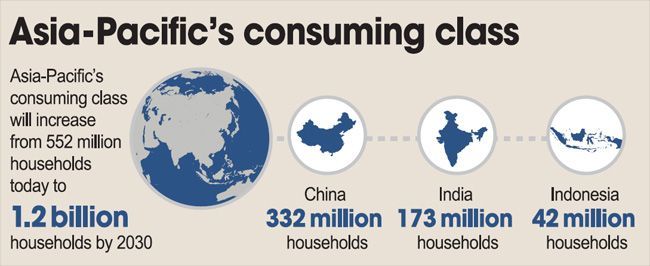
“Urbanization will drive a huge expansion in the region’s consuming class, which is expected to increase from 552 million households today to 1.2 billion households by 2030.” Much of this growth will occur in China, India and Indonesia.
In order to capitalize on opportunities generated by rising consuming class, companies must develop a strategy tailored to each city.
“New players will need to manage distributors effectively and take a city-level, rather than a national view of markets. It will be critical to gather intelligence on smaller cities that many Western multinationals are likely to overlook,” the institute said.
Connected but aging world
The acceleration of technology developments together with the rise of emerging economies is expected to deepen and broaden the cross-border flows of goods, services, and finance. McKinsey forecast that these flows, which totaled $26 trillion, or 36 percent of global GDP, in 2012, will nearly triple by 2025.
It pointed out that a number of major trade deals and economic agreements including the ASEAN Economic Community (AEC) and the Trans-Pacific Partnership (TPP) have the potential to create deeper links between countries in the Asia-Pacific region and the rest of the world.
The world is also facing a gradual decline in its workforce, with population aging across the globe.
According to the global consulting firm, there are three countries in which one fifth of the population has passed the age of 65 ― Germany, Italy, and Japan ― and thirteen countries will fit this profile by 2020, and 34 by 2030.
A mixture of the aging workforce and falling birthrates are weighing heavily on many Asian countries. The consultancy said that the only realistic option to address this issue is boosting productivity.
“Many Asian countries, including Japan, South Korea, Singapore, and Malaysia, will need to more than double their historical pace of productivity gains to sustain growth,” it said.
Huge opportunity for Korea
“I think the consequence of it (ongoing change), first of all, there is a huge opportunity for Korean companies. With the rise of middle class in Asia, Korea is going to see four billion consuming class people largely on its door steps,” Dobbs said.
“But I think Korean companies are going to face the threat of the rise of their competitors as well. Korean companies should be ready for that,” he added.
He emphasized that since technology continues to disrupt at a greater speed, Korean firms should focus on figuring out how they can benefit from that.
“Korean firms have done really well when televisions went from plasma to LCD and when phones went from feature phones to smartphones,” he said.
“The car industry is going through a major disruption with self-driving cars and battery-powered cars. Why is Korea not saying that it is an opportunity to rise to number one like it did with televisions,” he added.
One more thing Korean firms should do is to recognize the importance of new platforms and come up with a strategy to compete.
“Alibaba is a good example. It has a platform that allows small enterprises to sell around the world. Why aren’t Korean companies really present on Alibaba and Amazon?” he said, adding that having Korean firms play in that platform arena is important.