High time for Korean startups to enter Southeast Asia

A fintech startup's office in Jakarta, Indonesia. / Courtesy of Bang Jung-hwan
By Bang Jung-hwan
A startup boom is sweeping Southeast Asia. It is not confined to the IT sector ― virtually the whole gamut of industries across the region is jockeying for position in the boom attracting massive investment from around the globe.
Then “stars” have come ― in a case in point, leaders of Malaysia's tech company Grab became a target of nationwide acclamation after acquiring Uber's Southeast Asian business unit, which led to a dramatic change to the conventional industrial map in the region.
According to Tech in Asia, a Singapore-based online technology media outlet, startups in Southeast Asia attracted $7.9 billion in investment in 2017, nearly a three-fold leap from $2.5 billion in 2016. It was breathtaking given that the 2013 investment in Southeast Asian startups was a mere $1 billion.
The exponential increase has served as a catalyst for unicorn startups, which refers to private startups valued at more than $1 billion, to come on to the business radar. Major beneficiaries include Lazada, an e-commerce platform in Singapore, and Gojek, an Indonesian app-based ride-hailing service provider.
The startup frenzy is driven mainly by street-smart young Southeast Asians with an academic background in Western countries.
As the market evolves with passionate entrepreneurs with different interests and visions, business models become diverse and varied.
Major attention is focusing on attempts to introduce mobile technology to region-specific circumstances. And it is being extended to startups aimed at improving agricultural productivity, offering eco-friendly products or customized solutions for Southeast Asia's primary industry.
Indigenous family-controlled conglomerates have fueled the phenomenon by setting up venture capital operations and exploring business opportunities. It has inspired Korean venture capital providers to join the race.
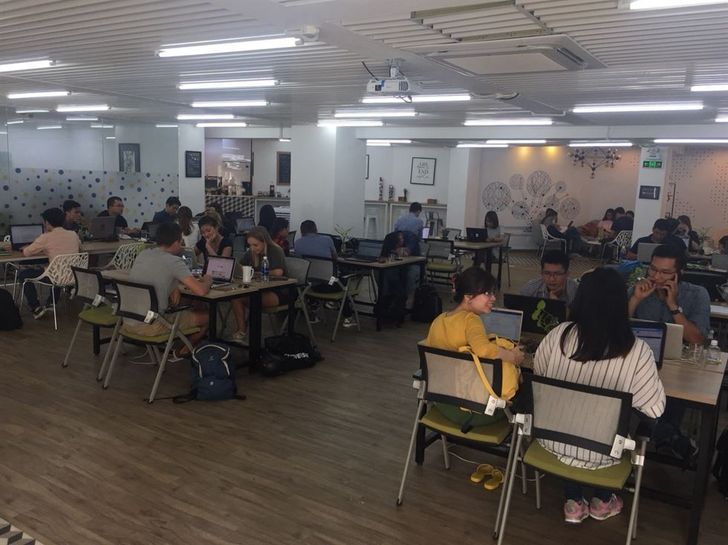
A co-working space in Ho Ch Minh City, Vietnam.
Why does Southeast Asia's startup market attract so much attention?
The main reason may be its high growth potential. Major economies in the region such as Vietnam and the Philippines are increasingly connected with the internet. According to the Wall Street Journal, the region adds whopping 120,000 new internet users every day. A study predicts that internet users in Southeast Asia will reach 480 million by 2020, which is almost the entire population of EU countries combined.
But it does not mean everything is rosy. Some issues still need to be tackled to get the startup craze to full maturity.
Poor IT infrastructure in rural areas, lack of a highly skilled workforce and widespread financial illiteracy are major obstacles. Apart from Singapore, capital markets and legal and institutional systems of many countries in the region are below international standards.
If these are left unchanged, venture capital, often referred to as “adventurous money,” will remain reluctant to join the region. It will be the same for Korean startups and venture capital, which which are drooling over the region's growth potential and profitability.
Nevertheless, I believe Korean firms should take a proactive approach. Local startup founders say they started their entrepreneurial journey after being impressed by success stories of startups in mainland China. It is a shame that few mentioned Korean startups as a motivator.
There are many segments in which Korean startups are competitive _ fintech, education and mobile games, to name a few. It is the right time for them to make inroads ― despite the lingering uncertainty and risks ― into the region.
This is because Southeast Asian market is too big to miss.
Bang Jung-hwan is director of ASEAN Business Center and author of “Why Indonesia?” He can be reached at
junghwanoppa@gmail.com.