Being offended by Korea
Courtesy of David Tizzard
By David Tizzard

The internet can be a fabulous source of information. It can teach you a whole range of things you never once considered or even thought possible. At the same time, in can introduce you to ideas that might not be quite as useful or important. For example, this week I learnt that saying “Korea is a mystery” is seemingly an offensive term to some. One frequent contributor to a social media page said that framing the country in such a way was enough to make their “skin crawl.” Imagine the sheer discomfort and physical violence this particular white dude must have experienced upon reading such a phrase. The horror! Luckily the person lives in Korea so there's a wealth of high-end cosmetics and treatments they will be able to acquire for their sensitivity. K-Beauty is a real thing and it's growing.
Dermatological recommendations aside, it would seem that the person so offended by the description of Korea as a mystery perhaps failed to realize one thing: to many people it still is. In a growing global population of near 8 billion people, how many of those do you think have a reasonable working knowledge of Korean history or culture? Very, very few. And that's not their fault.
Korea has suddenly emerged on the world stage and become a cultural, political and economic force to be reckoned with. In a few quick decades it has transformed itself from a place known only for cheap textiles or despotic regimes into one of effervescence, sophistication and attractiveness. For those that live here or study the place, of course the country is anything but a mystery. Its trials, tribulations, successes and challenges are well-known. So much so, in fact, that it's possible to become somewhat blase about what has been achieved, desensitized to what it suffers, or extremist in one's take on issues in order to try and rise above the cacophony of opinions.
But what if you're an accountant in Senegal, a dentist in Peru, or a low-paid worker in Kiribati with little to no knowledge of the country, are you then allowed to say, “Korea is a mystery” without fear of being called offensive?
There are many frames we can take when we explore the world. These are pictures in our mind with which we seek to understand that which goes on around us. According to how and where we grow up, we will have a certain set of frames that feel most comfortable, appropriate, even correct. They are part of us. Of our identity, culture, and way of seeing life. The frame of orientalism, for example, is an incredibly important tool for many marginalized communities ― and rightly so. Edward Said's work has assisted people in addressing “othering” and oppression and continues to give rise to important discussions on identity and representation. If you grew up in a post-1970s Western-styled education, it might have some relevance to you. Yet for other people, orientalism or, indeed, occidentalism, are simply not part of how they see the world.
Should they be? Are we to demand that others adopt the frames which we find important? To insist on such necessity seems to champion the very same process Edward Said was trying so very hard to resist many decades ago. By urging others see the world our way, are we taking the conversation forward or retreating even further backwards? This applies equally to a whole host of other issues. Cultural appropriation and queerbaiting are forever news items in the digital landscape, whether they be discussing Harry Styles or the latest K-pop banger.
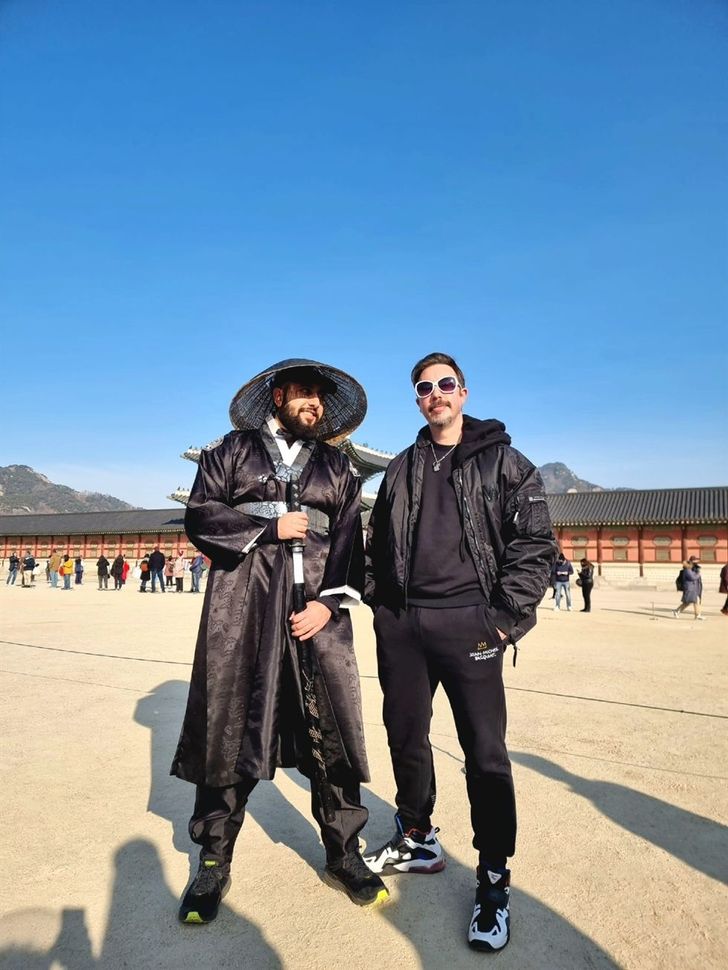
I took 25 international students to Gyeongbok Palace in downtown Seoul this week. They had a marvelous time wearing a variety of different colored hanboks, taking photos in one of Korea's most important historic locations. They were given a professional tour that described the importance of the buildings, the philosophical significance of water, the class-consciousness of the circles and squares designs the jagged paving stones, and the depictions of bats. The whole time they were smiled at, supported, and encouraged by the Korean people and other visitors around them. There was never once a suggestion that such behavior, the adopting of another culture's aesthetic features for personal enjoyment, was problematic or offensive. Of course, that's not to say that other people in other countries or cultures are not allowed to see it in such a way. If they want to, they can and should. It's just to reaffirm the idea that different people see the world in a wide variety of ways and for individuals or groups to insist on adopting the frame specific to their time and space is a little…well, unhelpful and, ultimately, not very accepting of other cultures. We can always go back to religiously-inspired universals and take bibles and other sacred texts around the world and demand that everyone learn, repeat and practice the “Word” or face eternal damnation but, to be honest, that approach seems a bit old-fashioned.
So back to Korea: Is it a mystery? Well, yes for some it is. For others, it's boring and something to be escaped. But to conclude with an idea on why a little element of mystery works so well for the country with its cultural products, one might suggest that a lot of Korean cultural products work on two levels: that they are similar enough in form, content, or aesthetic for non-Korean people to understand but, at the same time, different enough to provide a sense of freshness. It's a perfect storm in that if they were too similar or too different, they wouldn't resonate as deeply.
One of my Vietnamese-American students said that they are a fan of K-pop and Hallyu products because they found a form of representation that was otherwise lacking in American content that used films and TV shows to perpetuate stereotypes, and use Asian characters as punching bags. Korean content, on the other hand, provided positive role models to whom they could look up to. When I asked the young man why it was Korean products and not Vietnamese music or dramas to which he was drawn, he replied that the Vietnamese ones were too different. He didn't get them.
Thus Korean content wonderfully straddles a fine-line between that which is familiar and that which is strange. Such a position is, by its very nature, precarious. It could topple into cliche or absurdity at any moment. Moreover, the position won't appeal to everyone, and it won't always get it right. But when it does, it resonates with people in an incredibly positive way. If some people are drawn to Korea because it's a mystery, good on them. If some people find fascination in the familiar, bravo. We're all different. And, in a way, so is Korea.
Dr. David A. Tizzard (datizzard@swu.ac.kr) has a Ph.D. in Korean Studies and lectures at Seoul Women's University and Hanyang University. He is a social/cultural commentator and musician who has lived in Korea for nearly two decades. He is also the host of the Korea Deconstructed podcast, which can be found online. The views expressed in the article are the author's own and do not reflect the editorial direction of The Korea Times.