Beholding Queen Min

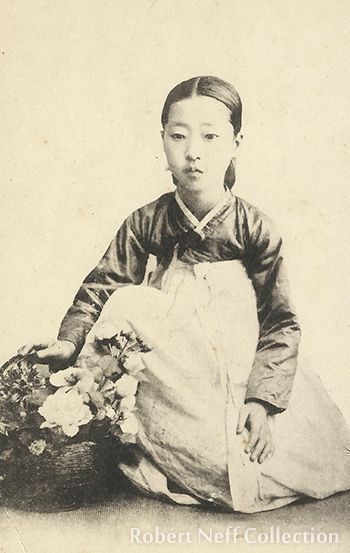
A hauntingly beautiful image of Korean gisaeng. Circa early 1900s. Diane Nars Collection
By Robert Neff

A photograph alleged to have been Queen Min but now generally dismissed as being a court woman. Circa 1890s. Terry Bennett, Korea: Caught in Time.
The great Moby Dick of Korean photographs is, undoubtedly, a picture of Queen Min (Empress Myeongseong). Over the years, there have been many alleged photographs presented by various experts and collectors but all have been dismissed.
It is hard to imagine a male being granted permission to take a picture of the queen (women ― especially those of the upper classes ― were generally kept from the view of strangers) and the few female photographers ― Isabella Bird Bishop, Lillias Underwood and Elizabeth Graham ― who had access to the queen make no mention of ever taking her picture.
Not only are there no photographs, there are ― apparently ― no portraits. In the summer of 2017, an alleged portrait of the queen was on display at the Daboseong Ancient Art Museum in Seoul but there were serious questions as to its authenticity.
So we are forced to rely upon written descriptions of the queen. These, however, vary depending on the writer. Some, like Bishop, described her as “a very nice-looking slender woman, with glossy raven-black hair and a very pale skin, the pallor enhanced by the use of pearl powder.”
Others had less-than-flattering opinions. The daughter of Augustine Heard ― the American minister to Korea ― described the queen in her journal as:
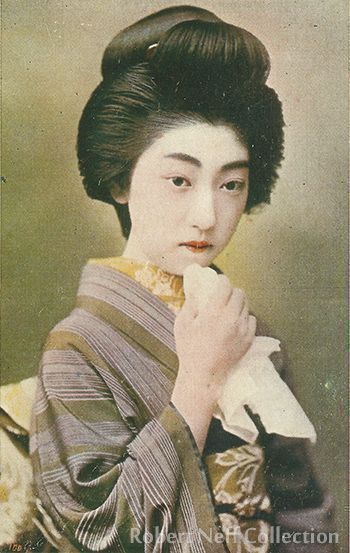
A postcard kept of a Japanese soldier who served in northern Korea in the early 1940s. Robert Neff Collection

Terry Bennett's book “Korea: Caught in Time”
“The Queen is small, not pretty but having grace & charm of manner. She was affable & talkative. Her face was as white as this paper with powder & paste & she also wore a huge chignon minus the wooden thing. Instead she had Chinese jewelry stuck in all around it which was quite becoming & quaint. But her teeth were horrible ― black & irregular.”
Although the queen might not have been photographed there were plenty of Korean women who were. Their images graced postcards and were readily purchased by visitors to Korea and collectors abroad. Apparently Japanese soldiers also collected these images in much the same way American soldiers and sailors collected pin-up girls (American movie stars) during World War II and the Korean War. It seems somewhat curious that the early American gold miners in northern Korea (1890s-1939) favored images of Japanese geishas to those of Korean gisaeng.
I guess beauty is in the eye of the beholder.