Are you human?

Heo Chang-hee, left, and Ahmed Askar. Courtesy of Neil George
By David Tizzard
“When I look into my daughter's eyes, I don't want to see sadness, suffering, pain or fear. I want to see joy, love, happiness and hope. Is this too much to ask for?”
Sentiments with which, I am sure, that all of us would agree.
These were the words of a young Yemeni man who had recently arrived on Jeju Island with his family, seeking shelter, freedom, and safety from the war that had destroyed his home, his country, and ― for the time ― his hope.
Now do you still agree with the sentiment?
This, obviously, is when things get difficult for some people. We all want to make aspirational statements and claims of peace or unity, particularly on social media where we will get likes, retweets, and hearts for our 140 characters.
Yet some sociologists have described such behavior as “slacktivism”: the practice of supporting a political or social cause by means such as media or online petitions, characterized as involving very little effort or commitment and with the main purpose of boosting the egos of participants in the movement.
So, are communities really ready to embrace those in need and suffering from the perils or war, violence, and revolutions elsewhere?
That's a difficult question for any country, particularly one with a traditionally “homogenous” culture as well as its own current socio-economic problems.
Nevertheless, it is pertinent to remember that this land ― both North and South ― has relied on the economic and political help of others over the years. That the two states were founded by men (Rhee Syngman and Kim Il-sung) who both had to leave their homeland because of internal difficulties. That their land has suffered division into two governments and with two leaders claiming legitimacy. That external influence has ripped them apart.
The similarities are there should one wish to see them.
But rather than make historical comparisons between two peoples, it is surely wiser to see things as they are today and through the eyes of the humans with whom we can interact face-to-face.
At the Seoul International Film Festival this weekend, I had the opportunity to sit down and talk to Ali Alhutaiby and Mahmood Alshawafi. Both were well-spoken, well-dressed, courteous young gentlemen, and they interacted freely with those that had come to hear their story.
Most importantly they stressed that they wanted to be seen as human beings ― not as a nationality, nor as a religion. They did not want to be labelled or stereotyped, but rather seen as people, like you and I, with a voice.
With hopes. With passion. And with family.
“We cannot choose where we are born. But we can choose how we live.”
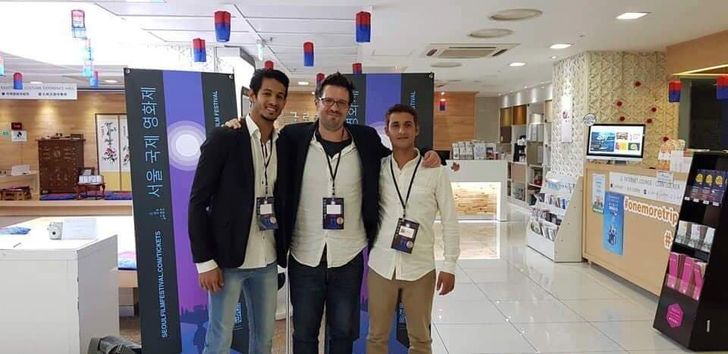
Ahmed Askar, left, Neil George, center, and Ali Alhutaiby. Courtesy of Neil George
Sadly many born in Yemen face famine, cholera, war, humanitarian issues and ― ultimately ― death.
Ahmed Askar, a national athlete who competed in the Asian Games here in Incheon in 2013, was forced by his government to give up his career as a kickboxer and to take part in a war in which he simply did not believe. After refusing to fight, Ahmed was imprisoned.
Yesterday he recounted to us how his friend ― another Olympic athlete ― was confirmed dead on Friday trying to make his way to Spain from Morocco.
He had drowned on this way there. But there was no photo in the national press. There was no internet uproar. There was just one's man grief ― and what used to be disbelief.
The stigma of Jeju still hangs around these Yemeni gentlemen. When meeting people here in Korea ― particularly in Seoul or the surrounding areas ― the mere sound of the word is enough to conjure up negative images in people's minds.
That unfortunately is the result of misinformation, falsehoods, accusations, and ― frankly ― a lack of awareness about global events and the reality of the situation affecting people.
Of course, like any country, including my own, there are those that support those in need and those that are more anti refugee and immigration. However, one man who has demonstrated himself to be a champion of all those that society has downtrodden or forgotten is British filmmaker Neil George.
After exploring Korean society's reaction to the Sewol disaster and how it shook the lives of those involved, Neil found the next story that needed to be told in the lives of these people from Yemen, struggling far from home and trying to be seen as human.
His three short films on the subject (Hope, Passion, and Family) explore their journeys and seek to raise awareness. They allow people like Ali, Mahmood, and Ahmed the opportunity to speak. To give their voice a platform that was often missing in the many other reports.
And Neil has certainly achieved that. The films give you the chance to breathe. To reflect and to empathise. To internalize what you are seeing and how it can, and should, affect you personally.
They are not a mind-numbing attack on the senses or an overtly didactic tug of the emotions. Rather they are a call to humanity. To that which unites us rather than that which divides.
That is one reason why the UN Refugee Agency has taken a great interest in Neil's work and lent their official support and funding to his project. Senior PI Associate Heinn Shin said that often times the public do not want to listen to reports or statistics. Sometimes it requires a more effective, artistic medium to really get a message across.
Thus while Neil provides the platform, it is the voice of these people that is expressed.
The Yemeni gentlemen have also found support here in South Korea from the Catholic Church. They speak in glowing terms of Sister Catherine on Jeju who helped them with food, housing, hospitals, and clothes. Buddhist and Protestant groups have also demonstrated a willingness to help.
“You have to believe in humans before you believe in religions”, Ali said to me, moved by a compassion that had transcended ideology.
And, I must confess, I had been moved too.
Last year I wrote about the situation of the refugees in this paper, but I had yet to meet them. I was pontificating on things about which I had had no direct or real experience.
My calls for understanding and empathy were noble, but they were a reflection of my own inner desires: They were not the words and thoughts of the gentlemen I met yesterday.
What I have come to understand, however, is that our thoughts are far more similar than I could have ever imagined. And it is for that reason that I applaud Neil for sharing their story. Applaud the UNHCR for supporting the cause.
And respect the people who simply want to be seen as a human.
After all, we all have that in common no matter what else differentiates us.
Don't we?
Information on the UN Refugee Agency can be found here:
David Tizzard (datizzard@swu.ac.kr) is an assistant professor at Seoul Women's University.