Russians make headlines in Korean newspapers in 1890s

The Russian Legation, circa 1900.
By Robert Neff
In 1897, Russia enjoyed great prestige and political power in Korea.
The previous year, King Gojong and the Crown Prince had sought and been granted refuge in the Russian legation ― largely protected by the Russian military. This led to Russian officers and non-commissioned officers (NCOs) training the Korean Army and a Russian being made the financial adviser to the Korean government.
Even Koreans employed in the Russian legation enjoyed political power through their association. Perhaps the most important was Kim Hong-nuik. He became a trusted adviser to the Korean monarch and became embroiled in court intrigue that eventually resulted in his fall from grace and subsequent banishment.
Furious at his treatment, he later plotted to assassinate Gojong and the Crown Prince by lacing their coffee with a toxic substance. His attempt failed and he paid for it with his life.
The English-language newspaper The Independent frequently printed articles about the Russians and their affairs in Korea. It is interesting to note that in the beginning (1896) the articles portrayed the Russians in a positive light ― often the victims.
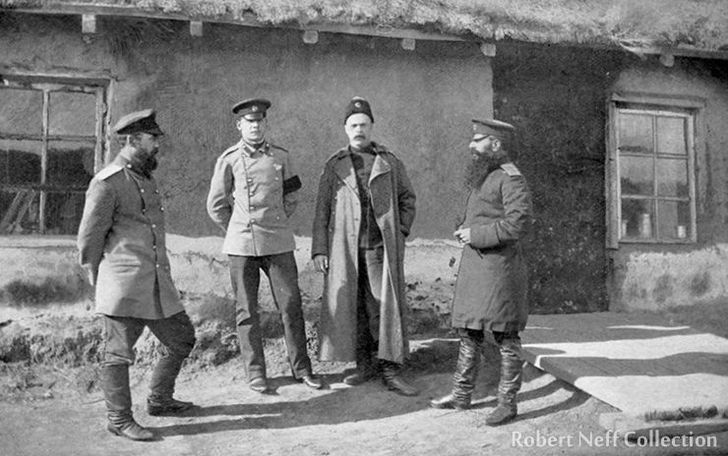
Russian officers, circa 1897.
In May 1896, two Russian Army officers, a colonel and a lieutenant, and accompanied by two soldiers, traveled through the southern part of the peninsula in pursuit of geographical knowledge.
The two officers separated, with the lieutenant bound for Busan and the colonel for Naju. On the way to Busan, the lieutenant “met a crowd of 6,000 rebels who took him for a Japanese and stoned him and took his baggage.” It was only with a great deal of difficulty that he was able to convince the Koreans that he was not Japanese and was allowed to continue on his way.
Even in the vicinity of Seoul, the Russian military officers found themselves the victims of Korean outlaws.
In mid-June 1896, a Russian officer and three of his soldiers stayed overnight in a Buddhist temple outside the city walls near the East Gate. While they slept, a thief made his way into their room and robbed them of “$200 in silver, 900 rubles in paper, a $600 Japanese bank draft, and one leather case containing some official documents.”
They immediately reported it to the Korean authorities and several police officers were sent to the temple. After a careful investigation, suspicion fell on a Korean living nearby. A search of the suspected thief's home revealed all of the stolen goods, with the exception of 800 rubles. The thief's fate is not given but undoubtedly he paid for his transgression with his life.
In 1898, the articles appearing in the paper no longer depicted the Russians and their Korean associates as victims but as perpetrators.
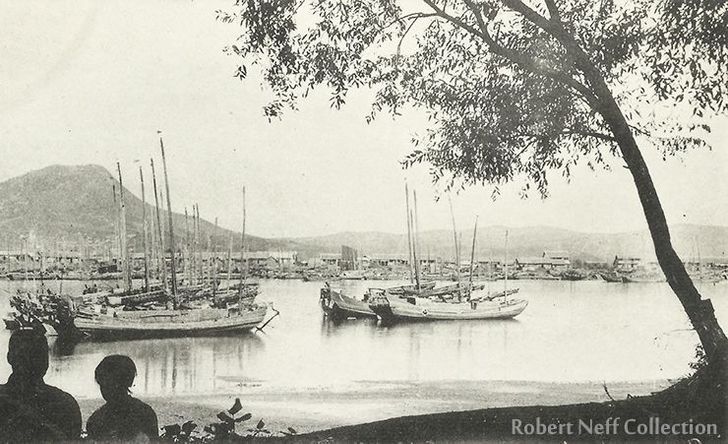
Wonsan circa, 1910-1930.
Kim Hong-kyung liked to wander the streets of Seoul dressed in European clothing and claimed to be a naturalized Russian and the brother of Kim Hong-nuik. Many of the residents in Seoul were afraid of upsetting the Russian authorities and Kim used this reluctance to his own advantage ― physically abusing those around him and probably extorting a good sum of money.
Kim's luck ran out in early May when the city residents could no longer tolerate his outrages and he was promptly arrested and turned over to the court for “suitable punishment.”
There were worse things to come.
On May 4, 1898, two Russian officers, eight soldiers and two Korean interpreters were involved in a deadly brawl in Wonsan. It was reported that the Russians had killed two sleeping Korean men and that thousands of the city's residents had surrounded the government office clamoring for revenge.
The editors of The Independent, however, expressed disbelief.
“We reserve our opinion until full particulars are known, but we doubt very much as to the perpetrator being a Russian military officer” and that the murdered men were sleeping at the time.
The incident was so serious that the Russian legation sent Paul de Kehrberg, the secretary of the legation, to Wonsan to investigate the incident and represent the Russian government.
It was later reported that it was not the officer who killed the men but one of his soldiers and the two Korean interpreters. Unfortunately, the outcome of the trial was not reported in the newspaper and we are left with many questions ― including why the attack took place.
Robert Neff has authored and co-authored several books including, Letters from Joseon, Korea Through Western Eyes and Brief Encounters.