A photographic history of Tapgol Park: Part 1

The front entrance to Tapgol Park several years ago.
By Robert Neff
In the middle of the hectic bustle of the Jongno district of Seoul is Tapgol Park (also known as Pagoda Park) ― a small quiet sanctuary generally frequented by elderly men who gather on the benches to regale one another with stories of the past.
Like the elderly men, the park literally breathes history.
It is especially associated with the Sam-il (3-1) Movement which took place on March 1, 1919, when Koreans throughout the peninsula and abroad, protested and denounced the Japanese occupation of Korea.
Tapgol Park was one of the key sites for these demonstrations. Memorializing the movement are large murals on the park’s rear walls.
The park is now well-maintained, but it wasn’t always this way and, as we will see later, partly owes its continued existence to the efforts of a Western advisor to the Joseon court.
One of the first Western visitors to visit what is now the park was Percival Lowell, an American, who stayed in Korea during the winter of 1883 to 84. While walking about the city he noticed a large stone pagoda [now National Treasure No. 2] barely visible over the roofs of densely packed homes.
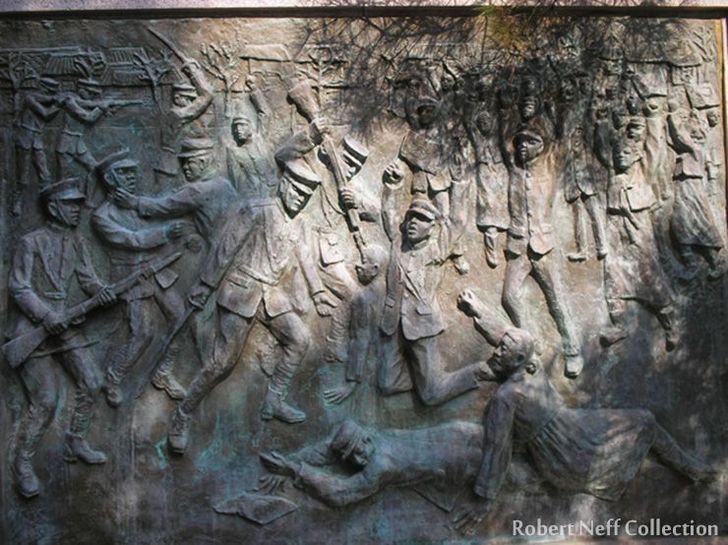
One of the murals on the park’s walls.
He wrote:
“It lies almost in the heart of the city, not far from one of the main thoroughfares; and it is while walking down this thoroughfare that one catches a distant glimpse of it.
“The distant glimpse never becomes a nearer view. From afar it is a conspicuous object, and on a closer approach it vanishes.
“It reappears only when it has once more been left a long distance behind; while from any other point of view than this street it is hardly visible at all.
“Piqued into curiosity, I determined to ferret it out and see what it was, even at the risk of dispelling the charm.”
After a great deal of trouble he finally managed to get to “an ill-kept little garden, in the midst of which rose the deserted solitary pagoda.” But the small park was so cramped that Lowell was unable to take a picture of it from the ground so he obtained permission to climb on a roof and snap a picture.
Lowell was somewhat aware of Korean culture. It was considered a serious breach of the peace for anyone to look over the walls of their neighbor as it violated the privacy of the women within. Apparently the neighbors were unaware that Lowell was going to be on the roof for he caught the glimpse of a Korean woman hanging up her laundry ― upon seeing Lowell she sought shelter “with virtuous rapidity.”
Considering the precarious perch he was on and the unwanted interest he was generating, the fuzziness of Lowell’s picture of is understandable.
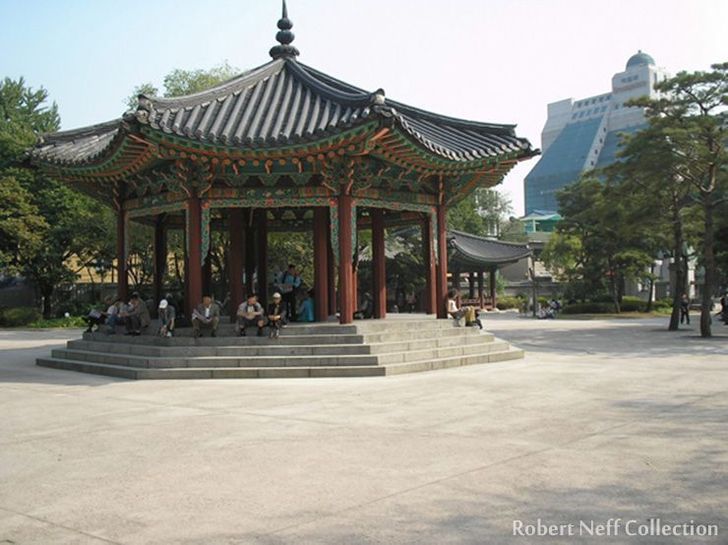
A shady place to sit
He later wrote:
“The pagoda was well worthy the toil involved in the getting a view of it. Although it was eight stories in height, it was composed, the whole of it, of two pieces of stone. Not, properly speaking, a real pagoda, it was an ornamental structure in the form of one.
“The stories were carved to represent an actual building, while what should have been their sides was exquisitely chiseled in bas-reliefs of celebrated personages.
“The white granite had become slightly discolored with age, but enough of its former purity remained to bring it into effective contrast with the somber gray of the houses.
“The garden in which it stood was a shabby, sad-looking little hole, not above twenty feet square; and the whole place, pagoda and all, looked ― as in truth it was ― utterly forgotten.”
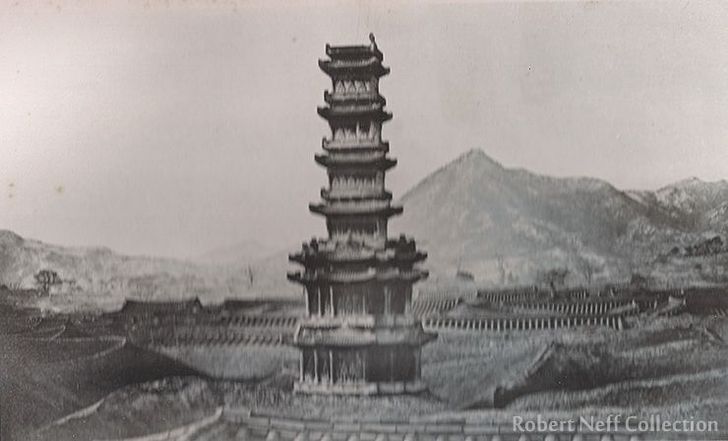
Percival Lowell’s picture of the pagoda circa 1883.