'Excuse me' 'Thank you'
By Oh Young-jin
.jpg)
If one says, “Excuse me,” the other wouldn’t say, “Thank you,” or “You’re welcome.”
This rhetorical anomaly may best capture the narrative Korea and the United States are having on the allegedly “smuggled” four launchers for the latter’s Terminal High Altitude Area Defense (THAAD) missile interceptor battery.
By all means the two allies do know the proper way of initiating and responding ― “sorry” or “certainly” to “excuse me,” and “you ‘re welcome” to “thank you.” So the chance is that it is part of their game to go one up on the other.
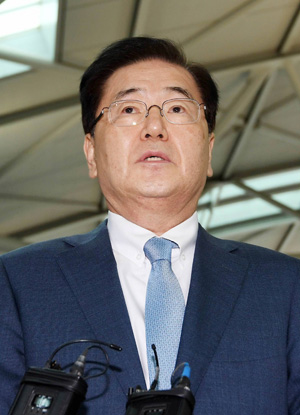
Chung Eui-yong
First, Chung Eui-yong, President Moon Jae-in’s top national security aide, went to Washington and met his U.S. counterpart, H.R. McMaster, to consult on the Moon-Trump summit in Washington this month. Upon his return, Chung said that McMaster thanked him for explaining the delay in the THAAD deployment due to an environmental impact survey Moon has now insisted on conditioning it on. Chung also said that Washington expressed its understanding on what Seoul claimed was an “intentional omission” of four THAAD launchers being brought into the nation during the Ministry of National Defense’s report to Cheong Wa Dae. Two launchers are already deployed at its Seongju, North Gyeongsang, site, but the four in question are now in storage.
There appears to be enough room for reasonable doubt about Chung’s claim. What did McMaster appreciate _ deployment delay or an explanation? Chung made it sound like the U.S. did both. But it is highly unlikely that the U.S. appreciated the delay because the missile interceptor is not just to protect Koreans but also to protect American soldiers here, likely one of the first targets of a North Korean missile attack. Also, the U.S. may as well see the new government looking a gift horse in the mouth. As a matter of fact, U.S. Senate Minority Whip Dick Durban of the Democratic Party obviously took offense when he said after his meeting with Moon that the U.S. could have other priorities to spend $1 billion on other than THAAD, if Korea doesn’t want it. Trump, a quixotic unilateralist, could be even more convinced about the reliability of the two countries’ alliance.
Then, McMaster’s word of appreciation would only cover the trouble Chung took to explain. McMaster’s “excuse me” was intended to reinforce the U.S. displeasure, while Chung responded with a “thank you.”
For the U.S. show of “understanding” over the snafu about the four launchers, it is worthy of scrutiny to appreciate what it really meant. Defense Minister Han Min-koo and Chung’s predecessor, Kim Kwan-jin, were questioned by Cheong Wa Dae about their failure to let Cheong Wa Dae know about them. Moon called it “shocking.” The whole affair has developed in such a manner as to make the U.S. an accomplice in the smuggling case. Kim and Han insisted that the report was made properly but the presidential office has yet to officially clear them. If the situation is so damning, what would “understanding” by the U.S. mean?
Perhaps, it is as if the U.S. said “excuse me” to reset what it sees as wrong, Korea responded, “You’re welcome,” taking it as the affirmation of Seoul’s stance.
During the recent multilateral regional security dialogue in Singapore, Minister Han met his U.S. counterpart, James Mattis. Han told Mattis that the environmental impact survey is not aimed at reversing the deployment or sending a “message” from the Moon government to the U.S. Mattis said that he trusted Seoul’s explanation.
Han, a leftover from the previous government, is out of touch with the new government so when Mattis said he trusted Han’s explanation, what did he mean? Perhaps, Mattis’s response could have been “thanks but no thanks” to Han’s “excuse me,” when he meant “sorry.”
Miscommunication between Seoul and Washington can be explained in two ways.
First, it represents anomalies typical at the start of their familiarization efforts. That means that the two sides will straighten them out and get back on track if they don’t have fundamental differences that affect the two countries’ alliance. The second is that they may prove a starting point of a dichotomy in their respective future paths, because one of the two or both are not satisfied with the status quo. That is what some fear from the progressive Moon government that is ready to realign itself ― getting closer to China and North Korea even at the expense of the alliance with the U.S.
It won’t take long to find out which is true. The summit around the corner will give the first telltale signs.
Oh Young-jin is The Korea Times’ chief editorial writer. Contact foolsdie5@ktimes.com and foolsdie@gmail.com.