The human side of North Korea

Korean-American writer Suki Kim teaches 19-year-old students at the Pyongyang University of Science and Technology / Courtesy of Suki Kim
Suki Kim describes undercover mission among Pyongyang’s elite
By Lee Ji-hye
Many watchers of North Korea experience a similar conundrum: While the country can be fascinating, there are few ways to get inside the country and really experience it personally.
Yes, the communist dictatorship allows tourists inside its borders; however, these travelers are constantly accompanied by minders and can only go where the Kim Jong-un regime wants them to.
Suki Kim, a Korea-born writer who is a naturalized American, believes that the problem with looking at the North strictly from the outside is that the humanity of its people is lost.
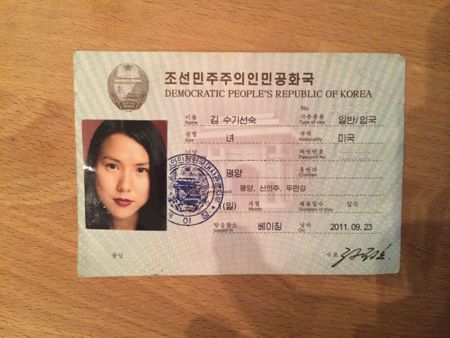
Kim's North Korean Visa / Courtesy of Suki Kim
Kim, 44, would know: In 2011, she spent six months as an undercover English teacher at one of the North’s elite universities, getting to know the people and the fears instilled in them.
In “Without You, There Is No Us: My Time With the Sons of North Korea’s Elite,” Kim describes her experience at the Pyongyang University of Science and Technology, where she lived, ate, and played basketball with the students.
“The humanity that I experienced by spending time in such close proximity with my students was the most remarkable thing that I felt,” Kim said. “It helped me see North Korea from the inside rather than from the outside.”
In the book, she writes, “When you talk to students, be very careful -- steer away from political issues, things that are too personal, or anything about the outside world.”
Of course, writing the book was impossible while in the North, where she was constantly watched. Still, she managed to take copious notes of her experience.
“Censorship was a big part of the experience being there,” Kim said. “It was about me watching myself, them watching me, and me watching them.”
In Seoul on a book tour for the Korean edition of the book, Kim sat down with The Korea Times to discuss her experience.
.jpg?w=728)
Kim at an interview with the Korea Times / Korea Times photo by Lee Ji-hye
Where did the idea to write work undercover come from?
My parents are from families separated by the 1950-53 Korean War, so there was a personal interest from an early time. Then I went to Pyongyang in 2002 in order to write a portrait on occasions surrounding Kim Jong-il’s 60th birthday celebration, and I felt that I wanted to write further. But it was such a limited society that I didn’t really know how. I was looking for a more in-depth experience, and I realized that I had to be “embedded” in order to do that.
Share an experience that sticks out in your mind.
I had assigned weekly letter projects to the students. There was one student that wrote a letter to me about a grade that he had received.
He had previously shown me another written project, and I had told him that it was “okay,” but he wrote that he felt betrayed by me after not receiving a higher grade. I remember telling him that “okay” doesn’t mean perfect and that I believed in his personal responsibility and will as an individual to better himself.
He did say something remarkable in return, which was, “I guess I’m so used to being doing what I’m told.” I remember that experience being an eye-opening moment.
What genre does this book fall into?
I would categorize it as literary non-fiction, not a journalistic piece, because I didn’t go in and do an interview. I’ve attempted to do so before, but you don’t go very far — you would simply get an expected sound bite. Memoirs…incorporate more feelings for the audience. My publisher decided they sell better, although I objected. But I guess it does have a more personal approach to it.
Has the North Korean government contacted you about the book?
I’ve been contacted by the school that had brought me there, expressing that they were highly displeased. They wanted me to not publish the book, and to also to give them the file before it went to print, so they could look at the content and change it. I felt so responsible for the subject as a writer — this was a very loaded one with gigantic responsibility on so many levels. It’s a subject that has a lot of repercussions, and I had to be responsible for it.
What was the most confusing thing about your experience?
At that time, I think I felt really conflicted always about what I was doing there, because awakening them could put them in danger. I wrote that I hoped they wouldn’t even wish for revolution, because I just wanted them to be safe.
They’ve become so real to me, and I think that’s what ultimately the experience was. If there would be sacrifices made to bring about peace in North Korea, let somebody else do it. That became a real dilemma for me, because my role being there was to give them new thoughts, opening them to the outside world, letting them know what freedom is and telling them what they’re missing out on as the future leaders of North Korea.
Do you feel that there will be change in North Korea? Is a democratic movement possible?
Democracy in North Korea is just not possible with the Great Leader. People say that some North Koreans have cell phones, and watch South Korean soap operas. But according to what I experienced, I did not experience an inkling of that. What I did experience and what matters is that they were afraid, and the fear is something that I experienced. Whatever they actually did or not, what I experienced was fear that grew on me as well. Their fear was very real to me. I do wish that they eventually know that I wrote this book. I hope their world would be better one day and that they would be able to read it, and that I made an attempt to humanize them.