'Cloud computing key for next robotics industry'
By Lee Min-hyung
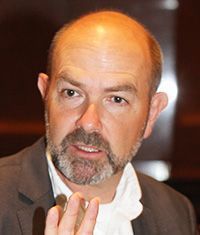
Chris Anderson, 3D Robotics CEO
Cloud computing will become the mainstream of an emerging robotics industry, as the internet-based data processing technology makes robots smaller, cheaper and more intelligent, according to 3D Robotics CEO Chris Anderson.
“The next chapter of drones will be to take full advantage of cloud robotics, and in doing so, will start to use many of the same technologies and infrastructure as autonomous cars,” the British-American journalist-turned-entrepreneur said in an interview, Wednesday.
“Cloud robotics is really about ensuring robots are connected to the internet and pulling down from a database at all times,” he added.
He stressed that robots also share the same platform as smartphones, so cloud-converged robots will follow the same footsteps of smartphones.
“Smartphones are getting smaller and cheaper. The reason for that is because they harness the cloud. Robots can also be smaller devices connected to massive information online. That is why drones and cars are built on the same platform as smartphones.”
3D Robotics is a California-based unmanned aerial vehicles manufacturer. Anderson made his Korea visit on the sidelines of this year’s Innobiz Global Forum in Seoul. Innobiz Association, in collaboration with the government-led Small and Medium Business Administration, has held the annual technology forum for five years, inviting globally-renowned tech celebrities each year. The latest keynote speakers at the forum include Apple co-founder Steve Wozniak and futurist Alvin Toffler.
The forum named Anderson as this year’s speaker in recognition of his impact on the global drone industry.
The 55-year-old drone company chief is best known for his bestselling book “The Long Tail.” In business and marketing, the long tail refers to the notion that large numbers of products in small quantities take up a similar or more market share than small numbers of bestsellers.
Citing the long tail perspective, Anderson underlined the importance of fostering more long tail developers for the growth of the IT industry. He said the U.S. could have globally-renowned IT firms ― such as Google and Apple ― due to its “open” environment which is related to the long tail.
Open systems are the key to America’s success in the IT industry, as for example, open clouds enable open systems which will then create more developers and more innovation, he said.
“The secret is the instinct towards openness, embracing long tail developers and companies. This will encourage entrepreneurialism which feeds more developers and firms again.”
Deregulation: global trend
Korea is famous for its industry-leading mobile and internet infrastructure, but critics have long pointed out that the country has so far failed to take full advantage of such an environment, as the country still heavily relies on one-sided development in traditional manufacturing businesses such as electronics and shipbuilding.
Excessive government regulations have been cited as the reason blocking the country from embracing balanced development in the hardware and software sectors.
“Any country that does not take the same approach (deregulation) will fall behind,” he said. “At this point, the path is very clear and almost all countries can follow. For example, Japan really wants to push the drone industry for its upcoming Tokyo Olympics in 2020. They are going to change, and they will come up with the same approach for deregulation.”
The growing numbers of drone users here voice complaints, citing complex and strict regulatory hurdles. But Anderson expressed optimism for the growth potential of the nation’s drone industry, as industrial robots are becoming more widely used in such areas as agriculture and construction.
For the deregulation, he advised Korea to follow the same path as Wi-Fi, opening the skies for small and low-risk drones with minimal regulatory barriers.
“Give the industry a sandbox and it will innovate massively. In general, innovation is around the ask forgiveness, not permission model, which does not do well in overly regulated markets,” he said.