Samsung mass-produces 128GB DRAM modules
By Lee Min-hyung
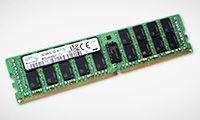
Seen in this photo is Samsung Electronics’ 128-gigabyte DRAM module with through-silicon via (TSV) technology. The company said Thursday that it has succeeded in mass-producing the modules to be used in building server systems and data centers. / Courtesy of Samsung Electronics
Samsung Electronics said Thursday that it has started to mass-produce 128-gigabyte DRAM modules for the first time in the world.
The company said the memory module, which uses through-silicon via (TSV) technology, will help its global clients build high-efficiency enterprise servers that will enable them to better manage their data centers. The TSV refers to technology utilizing vertical interconnections passing through a silicon wafer, guaranteeing higher energy-efficiency and speed than wire-bond or flip chip stacking.
The registered dual in-line memory module (RDIMM) enables processing twice as fast as the 64-gigabyte DRAM modules, and is about 50-percent more energy-efficient, according to the company. The module offers processing speeds of up to 3,200 megabits-per-second (Mbps), it added.
“Mass-production will enable global IT giants to launch their next-generation server systems in a timely manner,” said Choi Joo-sun, executive vice president at the company’s memory business division. “Samsung Electronics will continue to expand our customer base by forming more technology partnership with global IT market leaders.”
In August 2014, the company succeeded in mass-producing 64-gigabyte double data rate (DDR) 4 DRAM modules, opening the era of the DRAM market with three-dimensional (3D) TSV technology, the company said.
Samsung said it will lead the global premium memory market by expanding the use of TSV technology.
The company said that it plans to mass produce the 128-gigabyte DDR4 load reduced dual in-line memory module (LRDIMM) by the end of this year, boosting its drive to become the world’s leading memory provider by offering a full TSV lineup.
Samsung’s share of the global DRAM market reached a record 45.2 percent in the second quarter of this year, followed by 27.3 percent of SK hynix, according to a report by market research firm IHS. Micron Technology was third with 20.4 percent.