Gaming Special How concerning is video game addiction?

Social acceptance may trigger insidious pandemic
By Kim Jae-heun

Case No.1 - A 15-year-old middle school boy broke all the widows in his house in a fit of outrage when his mom tried to stop him from playing online games. Police were called.
Case No. 2 - A 17-year-old high school sophomore ran away after his parent stopped him from playing online games and lived from one PC bang to another.
These two cases were among the many game addiction cases that have been handled respectively by government-sponsored institute in northern Seoul and the Media Addiction Center, a private rehab facility in southern Seoul.
Regarding the first case, a counselor there said that a consultant had to make repeated visits for consulting, because the boy refused to leave and only paid attention to his game.
About the second case, a psychiatrist said, "he was an honors student but his life changed completely when he started playing League of Legends (LoL), the most popular online game."
The two cases illustrate game teenagers can get hooked irrespective of background, character and academic aptitude; and once addicted, it is hard to break the habit.
Both counselors refused to say whether the two had been rehabilitated, citing patient-doctor confidentiality.
Despite the dangers of addiction, online gaming was included in the annual National Sports Festival this year as a new competitive discipline.
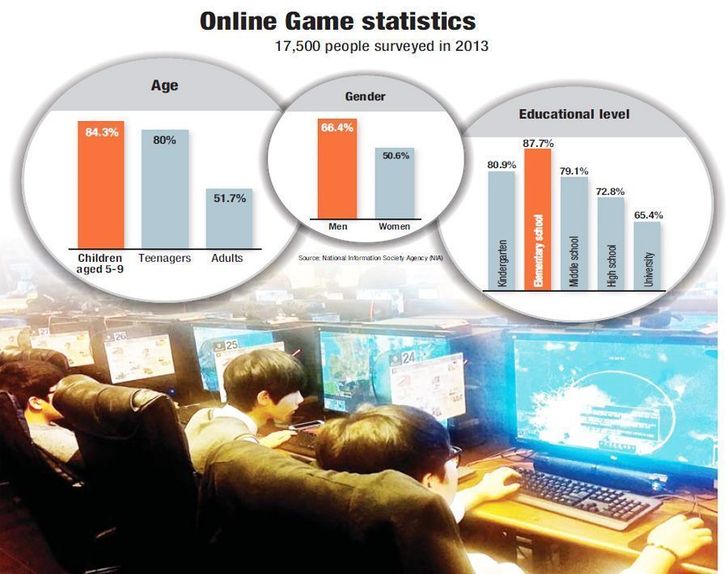
According to the 2013 research by National Information Society Agency (NIA), 84.3 percent of children under aged from five to nine played online games, while 80 percent of teenagers played them.
Kim Min-a, a manager at iWill addiction-counseling center in Changdong, northern Seoul, warns about teenage addiction.
"Teenagers are not as good at anger management as adults," Kim said. "Addiction can mean they fail in school, they fail at home."
Social factors loom large.
Game addiction is more common among teenagers from single-parent or double-income families, who are often left without parental guidance.
Every Wednesday, Lee Hyung-cho, a psychology counselor, visits Dure Forest Creative School nestled inside a mountainous area, secluded from the outside world. Lee, however, thinks that social factors are taken out of proportions.
"The game addiction rate among teenagers can reach as high as 12 to 15 percent. Up to 5 percent of teenagers were found to be in the high-risk group - a level where teenagers feel anxious when they don't play a certain amount of time or more, so they can't perform their daily routine," she said.
Lee Hae-guk, a psychiatry professor at Uijeongbu St. Mary's Hospital, says that too much gaming causes deterioration in partial brain function for teenagers.
"A part of brain that controls emotion, fun and pleasure develops until the age of 12," Prof. Lee said. "The frontal lobe that controls reasoning and decision making develops around 15."
"If children aged 10 to 14 are exposed to stimulating gaming for too long, their pleasure sense can develop excessively at the risk of dysfunction in the frontal lobe," the professor said.
One of the most bizarre cases he experienced covered a young man's sudden death after playing for three days straight with little interruption. During a
postmortem, Prof. Lee found a blood clot in a vein that blocked blood circulation to the heart.
"It is a severe case of game addiction," said Prof. Lee.
The game industry and its supporters refuse to believe that gaming is a cause of addiction.
Kim Sung-kon, executive director of Korea Internet & Digital Entertainment Association, argues gaming is not addictive.
He compares gaming with hobbies like collecting stamps and reading books. Spending hours doing it is not a sign of addiction but rather indulgence.
Kim said, "The same goes with gaming, a sport that you can enjoy playing for hours."
Kim admitted that a very small number of game addicts require medical attention, calling it an "aberration" from the norm.