Space dream put on hold
By Cho Mu-hyun
Will it lift off successfully next time?
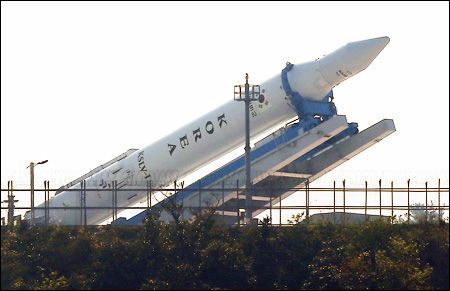
The launch of the Korea Space Launch Vehicle (KSLV-1), colloquially known as Naro was called off Friday due to a leak in a pressurizing container.
Staff, engineers and others showed a collective sense of disappointment but maybe they also felt a sense of relief because the KSLV-1’s previous two launches were unsuccessful.
It was one and half years ago when the second rocket blew up.
The wait is now continuing, but it could be more bearable, if we can be assured of success.
Any dream is hard to realize, and so it appears does Korea’s vision for space exploration. For now, there is little other than to keep our fingers crossed and hope that the third time will be a charm.
There are only nine countries that have succeeded in launching a space rocket. If the launch of the KSLV-1 succeeds, the country will become the 10th in the world to have a rocket takeoff from home and place a satellite in orbit.
It will officially join the space race, and join the rank of powerful nations such as the United States, China and Russia.
Symbolically, it will be a culmination of what Koreans as a people have achieved: our history of colonization, the war with the North and our economic success. At a civilization’s peak, it has always represented by things that go beyond money: Korea now exports more than just automobiles and handsets; put set the world buzzing with songs like “Gangnam Style” or movies such as “Pieta.”
Space projects aren’t really about making money: they never have been for NASA or others. No one relishes the story of Apollo 13 for how lucrative it was. It is about where we are as a people in the world and a representation of that.
Despite some protests about the spending on the projects, there have been other larger scale fiascos by the government in the past that produced little tangible value.
All things start with the seemingly unreachable goal at the time. What we take for granted now such as cars, phones or computers are good examples. Just look at Mother, the computer in the movie “Alien,” and compare it to what happens in the “Matrix.” Our aspirations, including our space project, will be realized before we know it.
In a forum held on Jeju Island in June, Kim Seoung-jo, the president of the Korean Aerospace Research Institute said, without any insinuation, that he could see Korea make commercial suborbital space planes in the not so distant future. Kim said there will also be personal flying vehicles moving among skyscrapers in cities after that. It’s highly likely he will have last laugh.