Irrevocable decline

Park Ji-sung has struggled to make an impact since moving to Queens Park Rangers.
Air is escaping from `three-lung’ Park
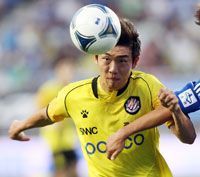
Korea international Yun Suk-young, will hope to make more of an impression after joining the west London club last week. / Korea Times file
By Kim Tong-hyung
When Manchester United won the 2010-11 Premier League, Park Ji-sung, the hardworking and versatile midfielder from Korea, made a difference.
Two years later, a string of listless performances at less glamorous Queens Park Rangers has observers wondering whether the 31-year-old is nearing the end of his time in European football.
Sir Alex Ferguson’s side has been just fine without Park’s services, widening the lead over cross-town rivals Manchester City at the top of the league, thanks to mainstays Wayne Rooney and Patrice Evra and the arrival of Robin Van Persie.
At the other end of the table, QPR, have managed just two wins, losing 12 and drawing 11 to remain dead last. Park is struggling to find minutes in a crowded roster.
Park’s struggles have yet to discourage his legion of fans at home, glued to the television through the wee hours waiting for their hero to make a game-changing play or score. To them, QPR’s match against Man City last week stung particularly.
Park, who played and excelled in numerous Manchester derbies during his seven-year run with United, didn’t appear until the 88th minute when manager Harry Redknapp brought him on for Esteban Granero. Park was booed lustily by the home crowd as he jogged onto the pitch, an image that has been replayed repeatedly by Korean television news programs.
This is obviously not what Park pictured last year when he signed with the Hoops and held up the jersey and captain’s armband with a beaming smile. He looked largely anonymous in his ten consecutive starts to open the season and has quickly dropped down the pecking order in favor of players like Granero and Samba Diakite while also being replaced as skipper.
Park’s decline has been painful to watch as the former Korea captain has always been defined by his non-stop running and industriousness, traits that earned him the nickname ``three-lung Park.’’ The QPR version is a timid and diminished player who seems confused about his role and out of ideas on how to influence a match.
In that magical season with Manchester United two years ago, Park scored eight goals and had six assists as he was a vital cog in the team’s deep midfield lineup. Park has yet to score for QPR and has just one assist.
``He needs to penetrate like he did before. Regardless of his role, he needs to show he still has skills and attacking instincts when he needs them,’’ said Jang Ji-hyun, a football commentator for SBS television.
Not that the transition was supposed to be easy. Park, a player who relies on his athleticism as much as his skills, was coming back after a knee injury. And moving from Manchester United’s stable environment to a club like QPR, where rosters and strategies change more frequently than Facebook updates, requires a dramatic adjustment.
Still, one would expect a player of Park’s status and pay, as well has his reputation for being ``indomitable,’’ to do more. It may be overly harsh to say that Park’s legend was merely a product of the world class players that surrounded him. A more glaring admission would be that his ability is beginning to wane.
While Park’s time with QPR and possibly in the Premier League may be running out, another Korean is looking to prove he has what it takes to succeed in one of the top leagues in Europe.
Left back Yun Suk-young, who grew up idolizing Park, signed with the west London club last week. He has been granted a work permit and will look to shore up the defense. Of course, that defense would have been tighter if Park had been able to perform better is his role as a defensive midfielder.