It's good for your game
Back to front: move it!
To many golfers, it seems counterintuitive that the action that starts the downswing in the upper body takes place in the back. Most players think it should be just the opposite because we seem to perform most of the swing with the front part of the body ― the hands, wrists and arms.
At the beginning of the downswing, it's important to start moving your target arm down to the chest, and control of that arm is aided by muscles in your back. Many inexperienced players allow the target arm and back shoulder to swing out toward the golf ball, a move that increases the chances of a slice or a pull.
Instead, when your latissimus dorsi ― a muscle that originates on the rim of your hip bone, spirals up your back and plugs into the upper part of your humerus, the big bone in your upper arm ― contracts during the downswing, it pulls your lead arm downward and across your chest. It works with the scapula (shoulder blade) to slot the clubhead in perfect position to release to the ball.
To get the feel of contracting the latissimus muscle, simply go to the top of your swing and pose, then drop your lead arm, feeling as if a point in the middle of your left scapula is actually contracting and pulling the left arm down.
Here's the big thought: You're not pushing the club down; you're pulling it down. And you're not using your arms, hands or any other part in the front of your body; you're using your back.
The age-old question is, "What starts the downswing?" Now you know the answer: In the upper body, the back moves the front.
Tomasi writes for Universal UClick.

Note how predominant this player’s left latissimus muscle is in his backswing. It’s stretched and ready to pull the club back down.
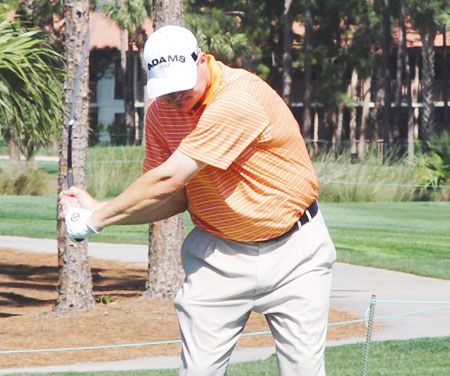
When the left latissimus muscle contracts, it shortens and pulls the clubshaft into position. Note how an extension of the shaft would intersect the target line, showing that the club is on plane and in the slot.