Chaebol leaders should be role model
By Christoph Heider
In the recent months, chaebol, respectively its representatives, have been hit hard in the media. For me a crisis is not necessarily bad. A crisis is a start to reflect, review and to change. Instead of being pessimistic, I am more optimistic that the right lessons are learned from these recent incidents.
People perceive the Korean chaebol rightly as innovative and powerful global players. Chaebol undoubtedly have contributed to the impressive economic development of Korea since the 1960s. It can even be stated that without chaebol and their impressive business extension, Korea would not be there where it is today.
It is true that politics and business have to work hand-in-hand ― politics cannot do without business and business cannot do without politics. The tight alignment of government and business targets in the 1960s was right so that Korea was able to generate highly needed economic growth. The question now is if this intense relation still fits to our time? Is the corporate structure of chaebol still the right business model to operate? The initiative proposed in 2012 by the current government to somehow restructure the underlying landscape for chaebol was a good and wise decision; unfortunately, that initiative somehow never got up to full speed.
Diversification is key! Politics have to provide a framework where businesses can develop. Businesses mean small- and medium-sized enterprises (SMEs) as well as bigger corporations. Korea is very much dependent on the conglomerates. In corporate business, you rather reduce the dependency on too dominant customers and instead develop a diversified customer portfolio. This is the direction Korea needs to go. We need an economic policy which is focusing more on nurturing SMEs and allow them to develop into auspicious companies. A healthy economic landscape allows SMEs to interact with other corporations in a fair and transparent way, on an arms-length principle, and on even terms. It also allows SMEs to develop from start-ups to “Hidden Champions.”
Compliance is key! Non-compliant behavior by company representative is a considerable business risk. It is not only that company representative might be indicted or penalties need to be paid ― the overall risk is much higher. The anti-graft law was a good start but actually what is even more needed, is management change. If we believe company homepages, each has implemented effective compliance systems to ensure compliance with applicable laws. The question rather is: Why doesn’t it work? First and foremost, the message must come from the top. The CEO of a corporation must be a role model and must stand for “zero-tolerance.” There is no way to be partly compliant. Compliance is a 100 percent commitment and must be part of every CEO’s skill set ― it must be in his or her DNA. It is quite obvious that we cannot expect employees to be compliant if a leader doesn’t send the right message. Compliance needs to become natural behavior in daily business life.
Transparency is key! Transparency is a prerequisite for corporate governance. What is needed is a transparent corporate shareholder structure. It is somehow surprising that efficient processes have made inroads into production but somehow have been completely neglected in group structures. The fact is that the organizational set up with cross-shareholdings is a nontransparent construct. Instead a simple holding-affiliates-organization is much more transparent as it is very clear who owns the company, who has management influence over whom, and what revenue and profit is generated overall. The holding’s supervisory board is then in the position to supervise company executives and group companies in a common and standardized way.
To end: Every crisis is a new start. “Team Korea” ― which means politics and businesses together ― has to make the right decisions. By doing so, Korea will develop further toward a fair and transparent business environment.
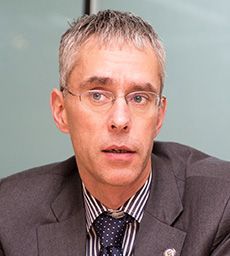
Christoph Heider is president of the European Chamber of Commerce in Korea.