N. Korea's missile launch fails again
By Jun Ji-hye
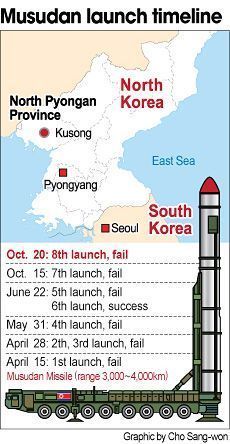
North Korea launched what was presumed to be a Musudan intermediate-range ballistic missile (IRBM), Thursday, which exploded soon after liftoff, according to the Joint Chiefs of Staff (JCS).
The launch took place at 7 a.m. near an airbase in Kusong, North Pyongan Province, soon after top defense and foreign affairs officials from South Korea and the United States wrapped up their high-level talks in Washington.
Experts say that the North was apparently attempting to show off its capability of striking U.S. military bases in Guam, though this failed, in response to the allies’ agreement to strengthen the U.S. “extended deterrence” protection of South Korea.
“The latest launch was seen as the North’s armed protest to show its willingness not to lose out to the allies’ plan to enhance extended deterrence,” said Kim Yong-hyun, a professor of North Korean Studies at Dongguk University.
Extended deterrence refers to Washington’s stated commitment to defend its ally by mobilizing all military capabilities ― nuclear and conventional ― to cope with the North’s aggression and provocations.
The Musudan, which can be fired from a mobile launcher, is believed to have a range of 3,000 to 4,000 kilometers and is in theory capable of reaching U.S. naval and air bases in Guam.
The U.S. Strategic Command also confirmed that it detected what it assessed was a failed North Korean missile launch, noting that the missile was presumed to be a Musudan.
It was the North’s eighth launch of an IRBM ― the seventh took place on Oct. 17 near the airbase as well, while six previous launches were conducted near the eastern port city of Wonsan.
Among them, only the sixth launch conducted on June 22 was considered successful. The Korean Central News Agency at the time claimed that the missile reached a maximum altitude of 1,413.6 kilometers and fell precisely onto a designated target 400 kilometers away at sea.
“We assess that the North pushed ahead with the additional provocation in a bid to recover from its failed launch on Oct. 15,” a JCS official said on condition of anonymity.
The repressive state deployed the Musudan missiles in 2007 without testing them. The continuous failed launches have cast serious doubts over the quality of the missiles.
But observers note that the North’s aggressive launch schedule despite repeated failures and further sanctions clearly shows its determination to achieve its stated goal of developing a nuclear-armed, long-range ballistic missile that could hit the U.S. mainland.
“The North is highly likely to launch more IRBMs as they are the only weapons the regime has at the moment that could threaten the U.S.,” said the official.
Meanwhile, Pyongyang indicated it would test a long-range rocket in the not-too-distant future, saying Thursday that it will continue to launch satellites into space.
The North claims that the launching of satellites is part of a peaceful space program, but the international community views it as a cover to test technologies used in the development of intercontinental ballistic missiles, believed to have a range of more than 10,000 kilometers, which are capable of striking targets on the U.S. mainland.
On Feb. 7, the isolated state launched what it claimed was an Earth observation satellite, Kwangmyongsong-4, into orbit.