North Korea's efforts to lure foreign capital fall short
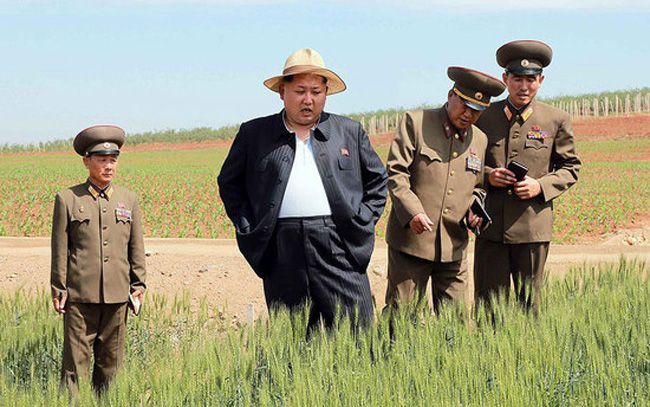
North Korean leader Kim Jong-un, center, inspects a special economic zone in the photo. The reclusive state has introduced laws and policies to lure foreign capital but they haved produced poor results. / Korea Times file
By Choi Sung-jin
North Korea has implemented various policies to attract foreign investment but the effects remain small, a private think tank says.
According to a report released by the Hyundai Research Institute Wednesday, the North entered the third phase of its policy to draw foreign capital with the inauguration of Kim Jong-un’s regime.
It was in 1984 that the communist state began pushing in earnest for foreign capital by introducing a law on joint ventures between North Korean and foreign businesses, targeting mainly Chinese investors and North Korean residents in Japan.
As part of efforts, the socialist regime also created a free-trade zone in the northeastern cities of Rajin and Sonbong in 1991.
The ambitious law and other policy efforts, however, produced little results because of the North’s one-sided operation.
The second phase began in 1998 by seeking economic cooperation and exchanges between South and North Korea and China. It was during this phase that South Koreans began to tour the scenic Mt. Geumgang in the North and the Koreas operated a joint industrial park in the North’s border city of Gaeseong. Pyongyang also launched a special project in Sinuiju, along the Sino-Korean border.
The Mt. Geumgang tours and Gaeseong Industrial Complex, however, are now suspended amid deteriorating ties between the Koreas. The Sinuiju project also has ended as a failure.
Since Kim Jong-un took control, North Korea has been implementing the third phase of the foreign capital-introduction policy. The North operates 26 special economic zones, including 21 economic development zones, around the country.
Eleven of them are concentrated along the Sino-Korean border but are experiencing difficulties attracting foreign investors since the United Nations tightened its sanctions on the reclusive regime.
The North’s economic technocrats have designated these special economic zones as districts for specific sectors, such as agriculture, tourism and up-to-date technology, but few have led to substantive foreign investment, the report said.
Officials in Pyongyang are going all out to draw foreign money by, for instance, trying to diversify investment targets away from China and South Korea and modifying related laws to better meet changing circumstances, to little avail, because they have fallen far short of reaching advanced, business-friendly levels, it said.
“Since the inauguration of the Kim Jong-un regime, North Korea has expanded the area open to foreign companies and diversified economic zones, as well as seeking would-be investors from countries other than China and South Korea, but produced little outcomes,” said Lee Hae-jeong, a fellow at the institute. “The possibilities of these efforts leading to substantive foreign investment are quite limited as long as the U.N. sanctions remain in place.”