Rio 2016: Science behind S. Korea's golds in archery, shooting

(From left) South Korea’s Ki Bo-bae, Choi Mi-sun and Chang Hye-jin won gold in the women’s team archery competition on Aug. 7. / Yonhap
By Choi Ha-young
Archery requires strong mental and physical ability. And South Korean archers proved they have what it takes at the Rio de Janeiro Olympics.
On Aug. 7, South Korean female archers won the women’s team event for the eighth time in a row.
On Aug. 12, Chang Hye-jin added gold in an individual event, while Ki Bo-bae, the 2012 London Games gold medalist, won a bronze medal.
Ku Bon-chan shot gold-winning arrows the next day.
Observers speculate about the reasons behind the seemingly invincible records, including Korean ancestors of nomads shooting arrows on horseback, traditional use of chopsticks or training with snakes.
Athletes, however, point out that their sophisticated training program is the main reason.
The archers trained on a range inside the Korean National Training Center in Tareung, northern Seoul.
“The set looks exactly the same as the Sambodormo archery venue in Rio,” said Kim Woo-jin, who led the men’s team competition on Sunday.
The athletes also watched a virtual simulation of archery events at Sambodormo while their brainwaves were being monitored.
“Looking at the simulation on screen, I could improve my concentration by checking which motions I should take in each phase during the game,” said Ki, one of the three archers who grabbed gold in the women’s team event.
The archers, including Ki, developed routines customized to fit their physiques.
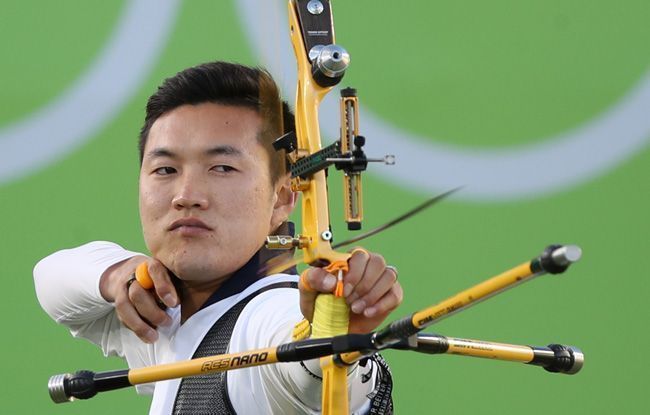
South Korea's Ku Bon-chan competes in the Rio de Janeiro Olympics. / Yonhap
The moment when athletes lose their concentration is called “choking,” Park Sang-hyuk, a researcher at the Korea Institute of Sport Science, told The Korea Times.
Choking also happens in daily life, like when people cannot find their mobile phones when they are actually holding them.
“When choking happens, athletes’ brainwaves fluctuate although they are not aware of it,” Park said. “A neuro-feedback lets them know when the choking moment hits.”
The athletes also practiced at a baseball stadium to overcome spectator noise and lights.
To cope with variables from wind and rain, they also practiced in capricious weather. They sometimes walked alone for 12 hours to settle their minds.
Ki used a note to relieve anxiety. The note reads, “I believe in my ability, my sense. Be positive. If it blows strongly, I aim at score 9.”
She always carries the note and tries to remember it at all time. Everyone in the team has similar notes or cards.
“In shooting or archery, athletes’ mindsets are extremely sensitive to one mistake,” Park said.
“We suggest each player has a way to calm themselves, and we continually provide feedback through counseling.”
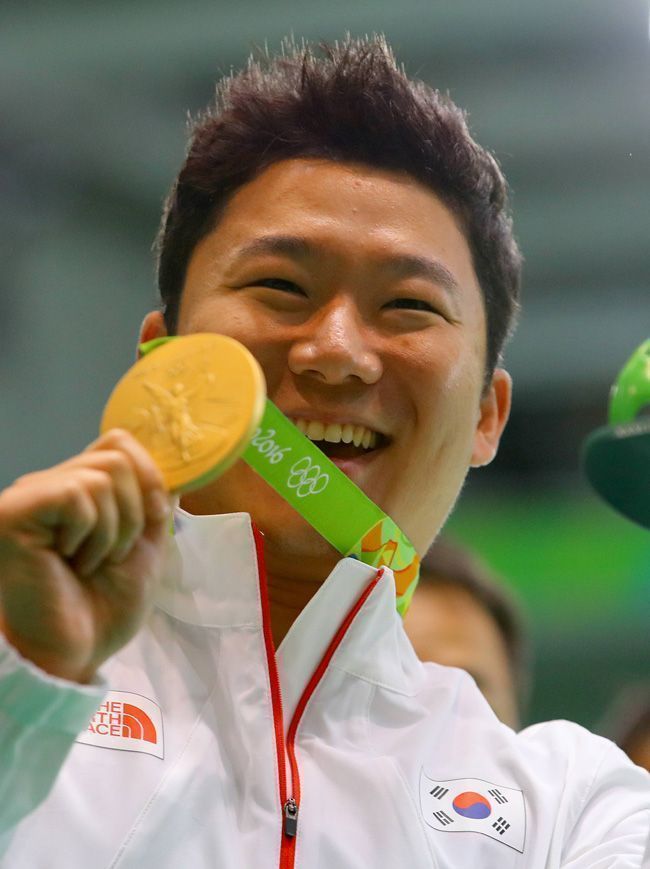
Sharpshooter Jin Jong-oh holds his gold medal from the 50-meter pistol event, Wednesday. / Yonhap
Gold medal shooter Jin Jong-oh recorded 6.6 points, but fought back to win gold.
“Some shooters mutter alone when they lose concentration,” Park said. “We have to find customized ways for individual players.”
South Korea is even exporting its archery coaches. In Rio, 10 South Koreans are coaching other nations.
Lee Ki-sik, master coach of the U.S. team, is one. Under Lee, the team won a silver in the men’s team event.
Before joining the U.S. team, Lee worked for team Australia.
Jin said he enjoyed fishing and the online game “League of Legend” to improve his concentration.
Park said the smartphone game was actually a good way to strengthen concentration.
Last but not least, the most basic training would be the athletes’ sweat.
“Every day, I shot from 400 to 600 times,” said Kim Woo-jin.