N. Korea may deploy SLBM within a year

A submarine-launched ballistic missile (SLBM) being fired early Wednesday in waters off Sinpo, Hamgyong Province. / Yonhap
By Yi Whan-woo
North Korea’s test-firing of a submarine-launched ballistic missile (SLBM), Wednesday, is raising concerns that it could deploy the weapons earlier than South Korea expected.
With the launch seen as a success, it also revealed that the military here underestimated Pyongyang’s SLBM technology and failed to accurately track its rapid progress. The missile flew 500 kilometers, well beyond the minimum 300 kilometers for a launch to be considered successful, before landing in waters under Japan’s Air Defense Identification Zone.
Defense officials here are reportedly looking at the possibility that North Korea will be able to operationally deploy the SLBMs by the end of this year.
Some military sources said the officials were wrong about their previous analysis that it would take four to five years for Pyongyang to fully develop SLBMs when the Kim Jong-un regime test-fired one on May 8, 2015. It failed in its initial flight stage.
While criticism was poured on the military and intelligence authorities here, President Park Geun-hye warned, Wednesday, that Pyongyang’s military threats were becoming “tangible.”
She cited the one-man rule of the unpredictable North Korean leader Kim Jong-un, who declared that the launch Wednesday was, “the greatest success and victory,” according to Pyongyang’s state-controlled Korean Central News Agency (KNCA), Thursday.
The KCNA said that the young despot also ordered the bolstering of efforts to develop transport devices for nuclear weapons.
“Under these circumstances, the government must make sure to analyze information thoroughly, to relieve the people’s anxiety by making sure that information is correct, and then bolster national defense, making it ready for any emergency,” said minor opposition People’s Party interim-leader Park Jie-won. “It’s so apparent that the government falsely informed the people concerning the North’s SLBMs.”
Yang Uk, a senior research fellow at the Korea Defense and Security Forum, speculated that the SLBMs were “in the final stage of preparation for deployment” along with the Musudan intermediate-range ballistic missile (IRBM). North Korea successfully launched a Musudan missile on June 22.
“The SLBM will be ready for use once North Korea develops the Gorae-class ballistic missile submarine,” Yang said.
Shin In-kyun, the president of the Korea Defense Network, claimed SLBMs could be deployed “within a month depending on Kim’s wishes.”
“Our military’s analysis on a possible time for deployment of SLBMs was based on a capitalistic way of thinking,” he said.
“It’s taken for granted in a capitalist society to let scientists work five days a week, to have days off on holidays, and to ensure that sophisticated weapons such as the SLBM pose no harm to operators before being deployed.
“However, North Korea mainly focuses on escalating threats against South Korea and it won’t matter if scientists and military officials work 24 hours a day and their health is at risk as long as SLBMs work fine,” Shin said.
To improve Seoul’s analysis about North Korea’s advances in nuclear and ballistic missile technology, Shin suggested taking Pyongyang’s latest emphasis on speedy work for production, such as “70- and 200-Day Speed Battle,” into account.
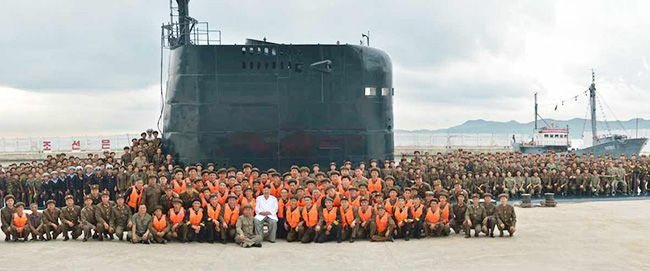
North Korean leader Kim Jong-un poses for a group photo with sailors after overseeing the SLBM test. These are among a set of 24 photos released by the North’s Rodong Sinmun, Thursday. / Yonhap
NK steps up threats
Meanwhile, Kim said the U.S. mainland and its territories in the Pacific region “will fall into our hands.”
It was speculated that the SLBM, which was launched using a lofted trajectory, could fly for more than 2,000 kilometers if fired on a normal flight path. The 2,000-kilometer travel range includes both South Korea and Japan as well as U.S. military bases there.
The KNCA reported that North Korea intentionally fired the SLBM to test the stability of “cold-launch” technology, which is essential to launch a missile from beneath the water, and other key factors.
“The SLBM fully met our criteria,” the KNCA said.
The Rodong Sinmun, the mouthpiece of the Workers’ Party, released a collection of 24 photos that showed Kim at the SLBM test site in Sinpo.
The dictator was seen watching the launch through binoculars with high-ranking officials, and hugging them after the test was successful.
The U.N. Security Council convened an emergency meeting at its headquarters in New York upon request of South Korea, the U.S. and Japan.
The majority of the UNSC’s 15 member states denounced North Korea for violating its resolutions and discussed ways to adopt a statement against Pyongyang’s “provocation,” according to diplomatic sources.