USFK commander defends THAAD deployment
By Jun Ji-hye
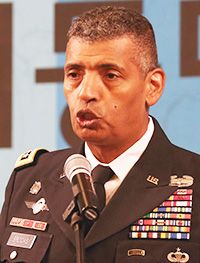
U.S. Forces Korea’s top commander Vincent Brooks gives a lecture in Seoul on the Korea-U.S. alliance, Tuesday. / Yonhap
The commander of U.S. Forces Korea said Tuesday that a U.S. anti-ballistic missile shield, scheduled to be deployed in South Korea next year, will better counter North Korea’s nuclear and missile threats, stressing that the system will pose no health risks to residents.
Gen. Vincent Brooks made the comment at a seminar hosted in Seoul by the Korea Institute for Defense Analyses, amid mounting safety concerns regarding the operation of the Terminal High Altitude Area Defense (THAAD) battery.
He said Seoul and Washington need to increase the layers of air and missile defense to counter the growing arsenal of missiles in the North, noting that “the recent decision to deploy THAAD was a good decision toward this end.”
On the safety issue associated with the electromagnetic waves emitted from the AN/TPY-2 radar of the system, the commander said no one will be closer to that equipment than the soldiers under his command.
“I would not recklessly endanger these soldiers while they are protecting someone else, neither would I allow them to endanger anyone they are trying to protect,” he said. “I do hope that those facts continue to meet the public so that there can be an acceptance of this important defensive capability.”
The comment comes as residents in Seongju County, North Gyeongsang Province, which will host the THAAD battery, have been rising up in protest, claiming the radar can cause cancer, infertility and hurt their agricultural products.
The residents have been calling on the government to withdraw the deployment decision, since the two nations announced the county as a location for the battery on July 13.
Gen. Brooks stressed that THAAD will add area protection and increase the ability to intercept North Korean missiles at higher altitudes.
“THAAD is a part of a layered system,” he said. “The continued procurement of Patriot Advanced Capability-3, or PAC-3 missiles, further enhances the defensive layers. The pursuit of Surfaced-Based-at-Sea Interceptors also adds layers to the defense.”
Washington has been trying to calm the anger and fear of Seongju residents by ― among other things ― showing its THAAD battery stationed in Guam to a group of South Korean journalists and allowing them to measure electromagnetic waves. But the residents still vow to protest strongly the deployment by mobilizing every possible means, including legal action.
Meanwhile, the commander also raised the need for improving the ability to share information within the alliance and beyond the alliance to multinational partners.
“Some of this is technical and some is a matter of policy. But I can tell you that we can operate more effectively if we work through this,” he said.
The comment was construed as him calling on South Korea to move toward signing the General Security of Military Information Agreement (GSOMIA) with Japan that would allow Seoul and Tokyo to directly share military intelligence.
While Japan has been hoping for the signing, South Korea has been lukewarm, apparently wary of public resistance, which stems from the bitter memory of Japan’s 1910-1945 colonial rule and the country’s wrongdoings, including Japanese soldiers’ use of Korean sex slaves during the war.
In 2012, the two countries were close to signing the GSOMIA but it fell through at the last minute due to intense public criticism of the government’s secretive handling of negotiations.