Seoul, Washington sign space cooperation pact
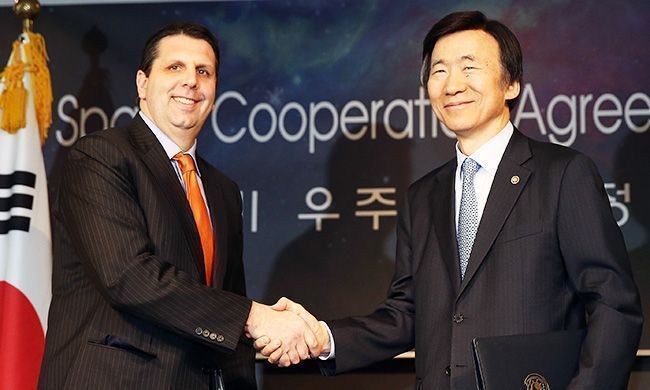
Foreign Minister Yun Byung-se, right, shakes hands with U.S. Ambassador to South Korea Mark Lippert after signing an agreement on joint space exploration at The Plaza Hotel Seoul, Wednesday. / Yonhap
By Yi Whan-woo
South Korea and the United States signed an agreement Wednesday to cooperate on space ventures.
Foreign Minister Yun Byung-se and U.S. Ambassador to South Korea Mark Lippert signed the “Framework Agreement for Cooperation in Aeronautics and the Exploration and Use of Airspace and Outer Space for Civil and Peaceful Purposes” at the Plaza Hotel in downtown Seoul.
This is the first time that the U.S. signed an agreement with an Asian country to work together on space exploration for non-military purposes, according to the Ministry of Foreign Affairs.
The pact was made in line with an agreement reached between President Park Geun-hye and President Barack Obama at a bilateral summit in October 2015 during Park’s visit to the U.S. The two leaders promised to expand cooperation in space exploration.
“The South Korea-U.S. alliance, which has continued to grow over the last 60 years, has gone beyond their military alliance,” Yun said in a speech at the event. “And this space cooperation agreement is one of the noteworthy achievements.”
Lippert said the inter-governmental treaty on space exploration “represents the very best of our relationship as two countries.”
“I think this represents that the U.S.-Republic of Korea alliance remains at the cutting-edge of technology and innovation,” he said. “This framework document along with the strong commitments of our two leaders and our research communities and our two peoples will help drive this forward.”
The pact will take effect after the National Assembly ratifies it and the South Korean government notifies the U.S. of parliamentary endorsement, according to foreign ministry officials.
They said the treaty does not require ratification from the U.S. Congress.
Seoul will seek to implement the treaty by January next year at the latest.
On the U.S. side, the National Aeronautics and Space Administration, the National Oceanic and Atmospheric Administration, and the Geological Survey will implement the agreement.
The Korea Meteorological Administration, Korea Aerospace Research Institute, Korean Astronomy and Space Science Institute, Korea Agency for Infrastructure Technology Advancement and the Korea Advanced Institute of Science and Technology are designated as partner agencies.
Scientists, engineers and other experts from the agencies will work on a wide range of fields, including cutting edge planetary exploration, earth observation, earth science and heliophysics.
Both countries will also have scientific data and expert exchanges.
Yun said the agreement will be especially meaningful, given that North Korea has been developing space technology in pursuit of nuclear weapons.
“There are, too regretfully, cases of exploiting space technology,” he said, citing North Korea’s satellite launch using U.N.-banned ballistic missile technology, Feb. 7 and two tests of submarine-launched ballistic missiles, April 15 and 23, respectively.
“Under such circumstances, the Seoul-Washington agreement to explore and use space for peaceful purposes is very significant.
“Cutting-edge space technology should not be used as a means for a zero-sum game. It should be used to help the international community resolve challenges together so that we can make a safer and prosperous world for future generations,” Yun added.
The signing of the space pact took place on the occasion of the second U.S.-ROK Civil Space Dialogue, which started in Seoul.
The working-level dialogue began in January 2015 to discuss how to bolster joint efforts in space exploration.
Key topics in this year’s dialogue include air quality, air traffic management and geostationary meteorological satellites to improve weather forecasts and warnings for the protection of lives and property.