Turn Toward Busan honors fallen UN soldiers

Korean War veterans who fought under the U.N. flag salute during the Turn Toward Busan ceremony, arranged by the Ministry of Patriots and Veterans Affairs, at the U.N. Memorial Cemetery in Busan, Wednesday. / Yonhap
By Jun Ji-hye
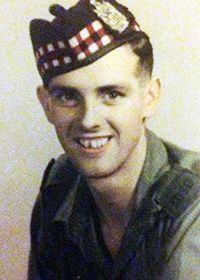
The late Robert Steed Holman McCotter when he joined the British Army in 1948. / Courtesy of the Ministry of Patriots and Veterans Affairs
BUSAN — Hundreds of Korean War veterans around the world offered a moment of silence on Wednesday, turning to face the direction of Busan where the fallen U.N. soldiers killed during the war are buried.
In the South Korean port city, 40 veterans from 11 countries including the United States, the United Kingdom, Canada and Turkey attended the ceremony that began at 11 a.m. in the United Nations Memorial Cemetery (UNMCK).
The Turn Toward Busan ceremony, arranged by the Ministry of Patriots and Veterans Affairs, was simultaneously observed in Canada, New Zealand and the Philippines. The ceremony was held in some 40 cities of the 21 nations that fought together to safeguard freedom decades ago.
The cemetery is the only place in the world where fallen U.N. servicemen are buried. According to the ministry, 40,670 servicemen of the 21 U.N. allied nations were killed during the conflict, with 104,280 wounded and 4,116 missing. A total of 23,000 U.N. servicemen were laid to rest at UNMCK.
The ceremony featured flags of the 21 U.N. allied nations, which were lined up in order of chronological entry of each country into the Korean War for either combat support or medical support.
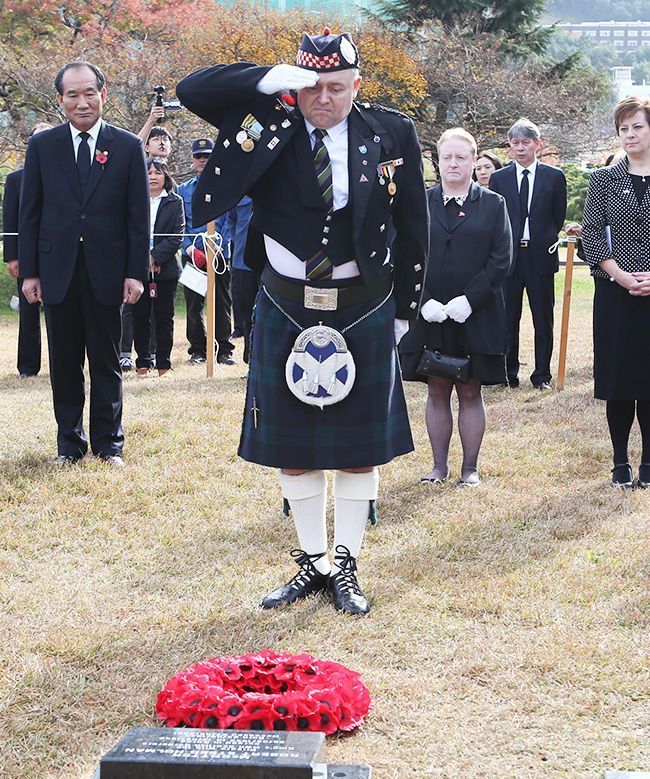
Gary McCotter offers a salute to his deceased father, Robert Steed Holman McCotter, a British Korean War veteran, during a burial ceremony held in the U.N. Memorial Cemetery in Busan, Wednesday, as Minster of Patriots and Veterans Affairs Park Sung-choon, left on back row, and other participants look on. McCotter senior stipulated in his will that he wanted to be laid to rest beside his comrades before his death in 2001. / Yonhap
The one-minute silent tribute began with sirens that sounded out across the port city. Even young kids made no sound during the moment of silence.
Minster of Patriots and Veterans Affairs Park Sung-choon noted that President Park Geun-hye also observed the one-minute tribute with her 140 aides at the same time from the presidential office in Seoul by turning toward Busan.
“We sincerely thank the U.N. soldiers for their act of love and courage,” Minister Park said during his commemorative address. “Thanks to their help, Korea was able to rise from the despairs of war and achieve splendid economic development.”
He vowed to continue full efforts to carry out a variety of programs expressing Korea’s gratitude for the sacrifice of the U.N. soldiers.
Vincent Courtenay, a Canadian Korean War veteran attending, fought in the war at the age of 16 and first inspired commemorative ceremonies to be held worldwide in 2007. “We are all proud of the 23,000 heroes for their supreme sacrifice,” he said.
Kim Hyun-woo and Kim Jung-hyuk who are students of Bukyong National University in their early 20s, said the ceremony was a chance to think about the war and appreciate the sacrifice of the soldiers who died.
“We are too young to have experienced the war so we cannot imagine how terrible it was,” Kim Jung-hyuk said. “I thank the U.N. soldiers for bravely fighting for this country that they did not even know much about.”
British vet buriedin Busan
An hour ahead of the Turn Toward Busan event, a burial ceremony was held for the remains of British Korean War veteran Robert Steed Holman McCotter, attended by his son Gary and daughter-in-law Karen.
Sergeant Major Alex Avis, staff assistant of the Defence Section at the British Embassy to Korea, said, “Mr. McCotter, your duty is now done.” Then, Gary McCotter, wearing a kilt his father bought him not long before his death in 2001, buried the remains of his father in the UNMCK, as requested in his father’s will.
McCotter said during an interview with The Korea Times that it was his father’s wish that he be laid to rest alongside his friends and comrades-in-arms.
“He felt when he saw how the country had progressed in such a short space of time that he had helped to make a difference,” Gary McCotter said. “He always wanted to come back and that was his request.”
The late McCotter came to Korea at age 19 and served in Korea for two years starting from 1950, after being attached to the 1st Battalion Argyll and Sutherland Highlanders, and the 1st Battalion King’s Own Scottish Borderers, respectively.
One of the battles he fought was the Battle of Hill 282 near Nakdonggang River, which was cited as the British Army’s most tragic battle of the war. While the Argyll and Sutherland Highlanders had captured the position and were preparing to defend against imminent enemy counterattack, three American fighter bombers mistakenly dropped napalm on the Argylls and strafed them with heavy machinegun fire, according to the ministry.
“My father fought in quite a bad battle, in which a lot of his friends and comrades were killed. My father was fortunate to be one of the ones that survived,” the younger McCotter said while gulping down tears. “He always wanted for his ashes to be brought back and scattered on the hill by the sea.”
The reason why the return of the late McCotter’s remains to Korea has taken 14 years was that his wife Agnes did not want to part with his ashes, the son said.
“My mother had a cabinet in the house with my dad’s Korean medals and stuff,” he said. “She wouldn’t allow me to do what my father wanted me to do. So unfortunately I had to wait until my mother passed away before I could do anything about seeing if I could get my dad’s wishes fulfilled.”
James McCotter, older brother of Robert McCotter and also a fellow Korean War veteran, was unable to attend the burial ceremony as he is now 90 years old, and his health was not good enough to travel to Korea, the ministry said.
Like most soldiers from the U.N. allied nations who served in Korea, the late McCotter received two medals for his service — the Commonwealth Korean War Medal and the United Nations Service Medal Korea.
Additionally, he and his comrades were authorized to wear the badge of the Republic of Korea Presidential Unit Citation.
Nov. 11 is an important day of commemoration for those lost in wars among many countries around the world, including the U.S. where it is celebrated as Veterans Day and Commonwealth nations which mark it as Remembrance Day.
Follow Jun Ji-hye on Twitter @TheKopJihye