NSO chief may face probe over F-35 deal
By Jun Ji-hye
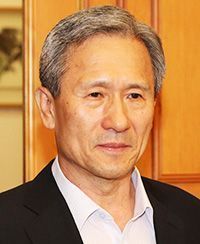
Kim Kwan-jin National Security Office chief
National Security Office (NSO) chief Kim Kwan-jin may face an investigation over his role in the controversial decision to buy F-35 stealth fighters from Lockheed Martin.
Kim headed a panel that selected F-35s over Boeing’s F15-SEs as a defense minister in March last year.
The office of the senior presidential secretary for civil affairs began its probe last week amid growing allegations that the Defense Acquisition Program Administration (DAPA) lied about the terms of the contract in order to help Lockheed win the bid.
The agency admitted that it failed to receive four core F-35-related technologies from Lockheed, and this is expected to cause a setback for the nation’s 8.5 trillion won KF-X project to develop indigenous fighter jets by 2025.
Kim served as defense minister from December 2012 to June last year. He also headed the Defense Acquisition Program Executive Committee that chose F-35 stealth fighters under the foreign military sales (FMS) format covered by guarantees from the U.S. government.
Controversy erupted following the decision to go with Lockheed because the decision came after the committee rejected Boeing’s F-15SE, first recommended by DAPA in September 2013.
DAPA officials noted that the decision to reject the F-15SE was unexpected as Boeing was more positive in handing over core technologies.
The rejection came after former Air Force chiefs of staff tried to exercise influence in the bidding by sending a letter to the presidential office in which they claimed the nation’s next-generation fighters should be F-35s with a stealth function, not the F-15SE.
Analysts say it is very rare for the civil affairs’ office to directly inspect military affairs. The NSO is the top organization supervising the nation’s defense, foreign and unification affairs. They say the rare inspection by the civil affairs’ office seems to reflect the need for looking into the NSO’s incumbent chief Kim.
The main job of the civil affairs’ office in general is to check on the service records of high-level officials, carry out discipline and counter corruption.
At the center of contention is why Korea decided to buy Lockheed Martin’s F-35s although the government was aware from the start that the transfer of the core technologies — the active electronically scanned array (AESA) radar, infrared search and track (IRST), electronic optics targeting pod (EOTGP) and RF jammer — which are essential for the KF-X project, was unlikely.
Kim Jong-dae, a military commentator and the chief editor of Defense 21 Plus, a monthly military magazine stated on his Facebook account that the NSO chief should be investigated.
“The person in charge who chose the F-35 without question after being pressured by the U.S. was then defense minister and current NSO chief Kim Kwan-jin. The presidential office should investigate why the committee chose the F-35 which has unfavorable terms for technology transfers,” he said.
Rep. Kim Sung-chan of the governing Saenuri Party also said, “You cannot say the military leadership did not know about difficulties in technology transfers in the F-35 deal. The leadership should take responsibility for not taking any actions to resolve the problem.”
The main opposition New Politics Alliance for Democracy said the remaining part of the parliament audit should clarify who is responsible for the botched F-35 deal and consequent setback dealt to the KF-X project.
The KF-X project calls for developing fighter jets to replace an aging fleet of F-4s and F-5s by 2025. The nation was planning to build some 120 jets after receiving technologies from Lockheed. But the U.S. government refused in April to allow the company to transfer the four core technologies.
Follow Jun Ji-hye on Twitter @TheKopJihye