10 Koreans killed in bus accident in China
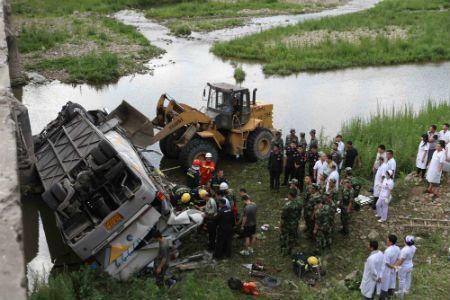
Rescue workers and investigators gather before an overturned bus carrying 26 Koreans beside a river bridge in the northeastern Chinese city of Jian, Wednesday. The bus veered off the bridge and fell into the river, killing at least 10 people, including nine Korean civil servants, and injuring 16 others. / Yonhap
By Kim Bo-eun
At least 10 Koreans, including nine civil servants, were killed in a bus accident in northeastern China, Wednesday, according to the Ministry of Foreign Affairs.
The bus, carrying 26 Korean passengers and two Chinese, veered off a bridge and fell 15 meters into the river below at around 3:30 p.m. (local time), a ministry official said. Among the Korean passengers were 24 public servants and a tour guide.
The victims are nine municipal and provincial officials and the tour guide, he said. They were from Seoul, Busan, Incheon, Gwangju, and four provinces including Gyeonggi, Gangwon and Jeju, according to the ministry.
It said 16 other passengers were injured, adding the death toll may rise as four of them were severely hurt.
The ministry official said the bus left the northeastern Chinese city of Jian in Jilin Province and was about halfway to its destination, Dandong, which borders North Korea.
He quoted some witnesses as saying that the bus was speeding before it plunged into the river. But the Chinese authorities have yet to figure out what caused the tragedy.
He said the injured were taken to a hospital in Jian with the nine bodies placed in the hospital mortuary temporarily.
The Korean passengers were traveling there on a training program organized by the Local Government Officials Development Institute, which is affiliated with the Ministry of Government Administration and Home Affairs.
A consular official based in the nearby city of Shenyang has been dispatched to the scene and the Korean government has formed an emergency response team.
A total of 143 Korean officials were on six buses travelling to Dandong.
The officials were on a workshop that started Monday and was scheduled to finish Friday. The training program included field trips to Jian, Dandong, Yangji in the Korean autonomous prefecture of Yanbian, and Dalian in Liaoning Province.
They were scheduled to look around historic relics of the ancient Korean kingdom of Goguryeo and Bohai in northeastern China. They were also supposed to visit sites of Korean independence movements against Japanese colonialists in the early part of the 20th century.