Gov't to go migrant-friendly
By Kim Se-jeong
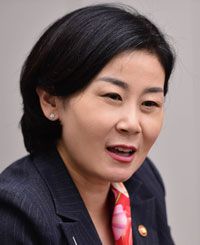
Kim Hee-jung Gender equality minister
Gender Equality and Family Minister Kim Hee-jung has promised policies that are friendlier to interracial families.
“It’s critical to help society understand that we are becoming a multicultural society,” Minister Kim said in a recent interview. “Marriage immigrants are here, all doing their part.”
As of 2013, the number of such immigrants stood at 280,000 ― adding their spouses and children makes this 750,000. The ministry expects the number to reach 1 million in 2020.
Kim, a lawmaker of the ruling Saenuri Party, played a crucial role in the establishment of a support center for interracial families in her constituency in the Yeonje district of Busan.
She was a member of the National Assembly Gender Equality and Family Committee last year before becoming minister in July this year.
“Making a new policy is necessary. But what’s more significant is to disseminate the information so that people take advantage of it,” she said.
“No work in my ministry can be successful without close coordination with other ministries,” Kim added.
The Rainbow School, an academic support program helping young school-aged immigrants in their early settlement, is a joint project with the Ministry of Education and Ministry of Culture, Sports and Tourism. Together with the Ministry of Labor and Ministry of Agriculture, Food and Rural Affairs, the ministry also gives prospective female farmers training. The Ministry of Justice is probably the closest partner, which is tasked to deal with immigration documentation and to seek out illegal marriage brokers.
The minister recognized the work of her colleagues.
“My colleagues are go-betweens. They are doing wonderful work with people from the other ministries,” Kim said in encouragement. It’s no secret that the bureaucratic Korean government system leaves little room for close inter-ministry collaboration.
Different ministries run different programs for interracial families, and they are often identical. Inter-ministry consultation has begun to streamline the programs, but, it has a long way to go because the goal is often about survival.
“It’s not just my ministry which should think innovatively,” said the minister.
Korea has seen the number of young female immigrants from Southeast Asia skyrocket since the early 2000s. That’s when lonely bachelors from rural villages here flocked to the region in search of prospective wives. The new trend prompted marriage brokers to emerge, boosting numbers even higher, with the peak in 2005.
Early settlers were the most vulnerable, with little support from the community or the government. News headlines on suicides and immigrants falling victim to violence in the home were easy to find.
The government response came in 2008.
The Multicultural Families Support Act, established in 2008, laid out a blueprint to give them necessary support. The authorities toughened the marriage qualifications for these women — this gradually curbed the rise of interracial marriages.
The act also gave way to the Multicultural Family Support Center and the five-year policy roadmap. Across the country, 217 support centers were created.
The ministry is now adding more support programs in response to the change in families’ needs.
Now more interracial families are becoming fluent in Korean and the immigrants have a sense of how things work in Korea. Under the second Comprehensive Roadmap, support programs provide academic aid for their children and offer more sustainable job training for spouses.
Sex slavery victims
Kim also vowed to address the issue of victims of sexual slavery by the Japanese military during the World War II.
The ministry holds an adamant view when it comes to resolving the issue.
“This is not a diplomatic issue between Korea and Japan, as many may think. This is an issue of human rights, and should be approached from this perspective,” she said.
No other time has the issue of the victims of sexual slavery been so recognized by people in and outside Korea. The peak came this summer when two victims, who were on an advocacy tour in the United States, were invited to the White House where they met with human rights specialists. Pope Francis, who was visiting Korea in August, also met with the victims, contributing to the awareness buildup. In January this year, the ministry also sponsored an exhibition of drawings about the victims which was held in France, raising awareness about the issue abroad.
As a parliamentarian, she advocated listing materials related to sexual slavery in the UNESCO Memory of the World. The ministry is currently collecting records and documents.