Another victim of sex slavery dies at 91
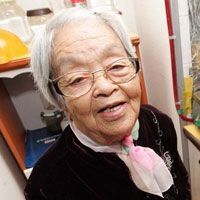
The late Hwang Geum-ja
By Kim Da-ye
Hwang Geum-ja, a 91-year-old victim of the Japanese military’s sexual slavery, died of natural causes Sunday. She was 91.
After Hwang died early Sunday morning at a hospital in western Seoul, the number of the Korean survivors who went through the ordeal of sexual slavery during World War II fell to 55. A total of 243 victims have been registered with the government.
Hwang was born in Hamkyung Province, now part of North Korea, in 1924. She started working in a glass factory in the province at the age of 13.
About three years later, she was sent to Manchuria and forced into sexual slavery until the end of the war, according to the Korean Council for the Women Drafted for Military Sexual Slavery by Japan.
She returned to Korea after its liberation from Japan, and lived alone in a public housing.
Although she registered as a victim of sexual slavery, she did not join in the campaign to denounce Japan for abusing her and several other women.
She is better known for her diligence and charitable activities such as donating her entire wealth of some 130 million won she earned from selling waste paper she collected on the streets.
She donated it to the municipal government to be used for a scholarship fund between 2006 and 2011.
NHK head draws fire
Just a day before her death, the new chairman of Japanese public broadcaster NHK stirred controversy when he said in his inaugural press conference that the forced recruitment of women into sexual slavery for soldiers was "common in any country at war.”
"Can we say there were none in Germany or France? It was everywhere in Europe," he said, according to reports.
According to Nihon Keizai Shimbun, Katsuto Mommii, the new chairman, said such sexual slavery is only considered wrong based on “today’s morality.”
He argued that Korea and Japan resolved this issue through a compensation settlement in 1965 when they reestablished diplomatic relations.
The report quoted him as saying, “Things are complicated because South Korea says Japan was the only country that forcibly recruited.”
International awareness campaign
Over the weekend, campaigns to raise awareness about victims of the Japanese military’s sexual slavery took place in France and the U.S.
In Paris, the Korean Council held its first signature collection campaign in Europe Saturday near the Eiffel Tower.
Korean students studying there and other expats joined the campaign to collect signatures from local residents and tourists as part of the awareness campaign.
The Paris event was part the Korean Council’s campaign to collect one hundred million signatures from across the world, to pressure Japan to officially apologize to victims of its sexual servitude and offer them appropriate reparations.
The 100-million-signature campaign also calls for the Korean government to come up with proactive diplomatic measures against Japan and for international organizations including the United Nations (UN) and the International Labor Organization (ILO) to help resolve the issue.
Beginning with the campaign in Paris where it held one of its weekly rallies last September with Kim Bok-dong, an 89-year-old victim, the Korean council plans to hold the next event in Berlin next month and continue hosting it throughout Europe.
On Friday, the Korean American Public Affairs Committee (KAPAC) held an unveiling ceremony for a monument recognizing the suffering of the victims at Eisenhower Park in Nassau County, New York.
The original text of the proclamation of the New York Assembly Comfort Women Resolution, which the state senate passed in January 2013, has been engraved on black granite. It was set up next to the comfort women memorial monument.
Tony Avella, a New York State Senator, and Charles Lavine, a member of the New York State Assembly _ who championed the passage of the resolution, participated in the ceremony.