Park, Xi agree on nuke-free Korean Peninsula
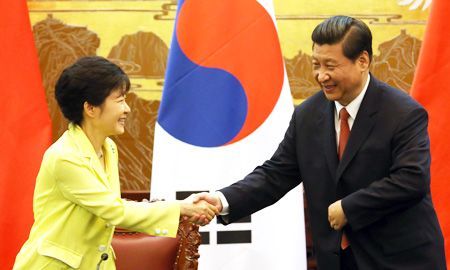
President Park Geun-hye, left, shakes hands with Chinese President Xi Jinping after issuing a joint communiqué at the Great Hall of the People in Beijing, Thursday. The two state leaders called for a swift resumption of the six-party talks to resolve the North Korean nuclear issue. / Yonhap
2 leaders want 6-party dialogue to be resumed
By Kim Tae-gyu
BEIJING ㅡ President Park Geun-hye and Chinese President Xi Jinping agreed Thursday that North Korea’s nuclear program is a “threat” to the security of the Korean Peninsula, the region and the world peace so it can’t be tolerated.
In the news conference after their summit, the two leaders called for the early resumption of the long-stalled six-party talks to disarming the North.
“North Korea’s nuclear armament cannot be allowed under any circumstances and the North’s denuclearization as well as peace and stability in the Korean Peninsula benefit both countries,” Park said.
“We agreed to continue strategic cooperation. We urge the North to comply with international obligations including the decisions of the UN Security Council and the Sept. 19 Joint Statement.”
The U.N. Security Council levied strict sanctions on Pyongyang after its atomic test in February and, unlike in the past, China has been also stern in deciding and executing the punitive measures against its long-time ally.
The Sept. 19 Joint Statement was the first tangible results of the six-party talks signed in 2005 when Pyongyang promised to abandon its nuclear ambitions in return for economic aid and the pledges of the United States not to attack the Stalinist state.
“We agreed that the Korean Peninsula should be denuclearized and the issues must be addressed through dialogue and cooperation,” Xi said. “As the situation has turned positive of late, I hope we will put forth efforts to restart the six-party talks in the near future.”
A joint communique announced after the summit is in tandem with the two’s remarks because it also articulated a nuclear-free Korean Peninsula and resumption of the six-party talks.
The six-party negotiations fell apart in 2009 when Pyongyang launched a long-range missile. It involved the U.S., Japan, China and Russia on top of the two Koreas.
According to the communique, China also highly recognized Park’s flagship North Korean trust-building policy, a carrot-and-stick approach of attempting to engage Pyongyang without tolerating any provocations.
In the communiquex, the two sides agreed to strengthen ties via setting up high-level security dialogue channels and creating a hotline between their foreign ministers.
The economic cooperation is another significant agenda of the summit with the two currently negotiating on the free trade agreement (FTA). Park said South Korea strives to increase its trade with China to $300 billion by 2015 from $256.3 billion last year.
They also agreed to extend the currency swap amounting to 64 trillion won that will expire late next year. It was inked in October 2011 to stabilize the financial markets amid the global economic downturn.
Of note is that the issue of North Korean defectors was not raised during the press conference or at the joint communique. It is unknown whether Park and Xi discussed it during their talks.
In late May, nine North Korean defectors aged between 15 and 22 caught in Laos were forcibly returned to their homeland, raising global worries for their safety as they were expected to face harsh punishment.
Thereafter, requests sprang up for Park to raise the issue during a meeting with Xi because most North Korean defectors escape to China via crossing the border between the two countries.
Park last month said that she would talk about various issues with Xi while insinuating that North Korean defectors would be part of them.