K-food set to boom in Turkey

FTA makes kimchi, ramyeon cheaper for Turkish consumers
By Lee Hyo-sik
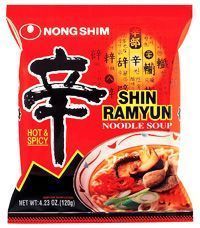
Nongshim’s Shin Ramyeon
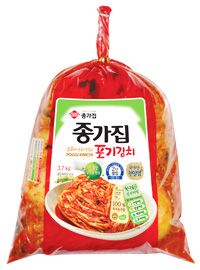
Daesang FNF’s Jonggajip kimchi
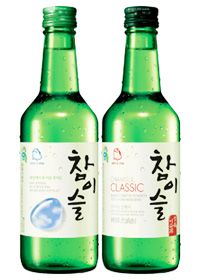
Hite-Jinro’s Chamisul
Korea has long maintained a close economic and political relationship with Turkey, which dispatched nearly 40,000 soldiers during the 1950-53 Korean War in the aid of the nation. The bilateral ties became even closer after a free trade agreement (FTA) went into effect on May 1, abolishing or cutting tariffs on a wide range of industrial and agricultural products for both nations.
In addition to automobiles, electronics, textiles and other industrial goods, made-in-Korea food and beverages are expected to gain greater popularity among Turkish consumers, thanks to lowered prices. On the back of “hallyu,” or the Korean cultural wave, Korean movies, dramas and pop music have become extremely popular in the transcontinental country, particularly among young people. This has fueled the demand for a variety of Korea-made products.
Government officials here say that Turkey will emerge as a blue ocean for so-called K-food, urging local food companies to be more aggressive in exploring the Turkish market.
Korean makers of kimchi, ramyeon and other food items are expressing high hopes for new business opportunities in the nation of 74 million people. Companies said they will establish a strong presence in Turkey to target increasingly wealthy consumers there and use the nation as a base for entering neighboring markets.
The Turkish government has also expressed hopes for closer economic ties with Korea, adding that the FTA is a win-win solution for both nations. It said that through the accord, it wanted to import safe, high-quality K-food items at lower costs for Turkish consumers, many of whom are seeking to get a taste of food products imported from Asia’s fourth-largest economy.
Korea-Turkey FTA to boost bilateral trades
In January 2008, Korea and Turkey began negotiations on the bilateral free trade accord. After engaging in intense talks for five years, both sides finalized the pact in March this year. It went into effect two months later.
According to the Ministry of Trade, Industry and Energy, the signed FTA concerns only cross-border trades of merchandise. The two countries are expected to start negotiations this year to open services and investment sectors to each other.
“Turkey will completely abolish tariffs on our automobiles, auto parts, textiles and other industrial goods over the next seven years. After 2020, all made-in-Korea products will be sold in Turkey tariff-free,” said Choi Dong-gyu, director general for the ministry’s FTA policy. “The size of the bilateral trade is forecast to increase as Korea exports more to Turkey.”
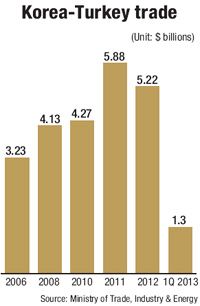
In 2012, Korea’s trade surplus with Turkey reached nearly $3.9 billion. It shipped goods worth $4.55 billion, while importing $672 million. The ministry expects the trade volume will rise by $740 million over the next 10 years.
Choi estimated that Korea’s GDP will jump by 0.03 percent annually thanks to the Korea-Turkey FTA. “We could reap greater economic benefits from closer ties with Turkey if we make the best use of its geographical advantage and customs-free accords with European Union. I think Turkey will become an important consumer market and a regional operational base for many domestic companies in the long run.”
The director said the transcontinental country has been acting as a manufacturing base for many multinational companies targeting European Union member countries, thanks to its customs-free agreement with the world’s largest economic bloc.
“Additionally, Korean companies interested in entering Africa and the Middle East need to consider setting up a presence in Turkey,” Choi said. “The government will encourage small enterprises to advance into the Turkish market for new opportunities. We will organize a series of briefing sessions to assist them in doing business in the country.”
Creating K-food boom in Turkey
Choi said the government has created a favorable business environment in Turkey for Korean food companies. “We successfully persuaded the Turkish government to abolish tariffs on kimchi, ramyeon, soju and other Korean food products. This presents a great opportunity for local food makers.” Soju is a Korean liquor.
He said the country’s food exports to Turkey are not large, but stressed that an increasing number of Turkish consumers want to taste a wide array of Korea-made food items.
“So far, Korean food products are mostly consumed by Koreans residing in Turkey and Korean tourists,” the director general said. “But ordinary Turks are seeking to enjoy kimchi and ramyeon because of the growing popularity of Korean TV dramas and movies. government has made the environment favorable for food companies and now is the time for them to enter the Turkish market and secure a large number of customers.”
Choi said the Turkish government was not opposed to eliminating tariffs on imported food products from Korea because it wanted to make them more affordable for Turkish consumers. “It is rather unusual for foreign governments to voluntarily lower tariffs on imported goods. But that’s what happened concerning our food items. The demand for Korean food items in Turkey will grow explosively over the next few years.”
The state-run Korea Trade-Investment Promotion Agency (KOTRA) has also been encouraging food companies, large and small, to take advantage of the Korea-Turkey FTA.
“We have been talking to food exporters about favorable conditions in Turkey. We have and will continue to hold briefing sessions for exporters,” said Park Jung-hyun, manager at KOTRA’s emerging market research team. “They need to know kimchi, ramyeon, soju and other items are now tariff-free in Turkey.”
Park also said KOTRA plans to organize a series of briefing sessions in Turkey to inform companies there of the free trade pact. “Many Turkish companies do not know about the FTA,” he said. “We would like to inform them about it. Then they may import more from Korea.”
The Ministry of Agriculture, Food and Rural Affairs has also taken steps to take advantage of the trade agreement with Turkey.
“We would like to make the best use of the FTA we signed with Turkey by boosting the exports of local agricultural and food products,” said Do Hyun-mee, deputy director of the ministry’s export promotion team. “We will first study the Turkish market to find out what products consumers want. We will then team up with local food companies to promote K-food there.”
Turkish Ambassador to Korea Naci Saribas also said kimchi and other Korean food items will be more popular among Turkish consumers. “These days everybody in Turkey knows about Psy and other K-pop singers. Many youths watch movies and TV dramas from Korea. I think kimchi and other Korean products will be well received.”
Saribas also said the FTA will help Turkish agricultural producers increase shipments of their products to Korea. “The trade should be beneficial for both parties. I am sure Turkish famers and companies will benefit from increased business opportunities in Korea.’
Kimchi, soju, ramyeon makers target Turkey
Korean food companies are beginning to notice growing business opportunities in Turkey following the FTA.
Nongshim, the country’s largest instant noodle producer, expects to double its exports to Turkey this year.
“We are glad that our products will be more price-competitive in Turkey thanks to the abolition of tariff,” a Nongshim spokesman said. “We know that Korean ramyeon and other food products are popular among Turkish consumers on the back of hallyu. We would like to take advantage of these favorable conditions to double our market share this year.”
Daesang FNF, maker of the nation’s best-selling Jonggajip kimchi, also expresses optimism toward Turkey, saying it will consider expanding its presence in the country.
“Our products have so far been consumed mostly by Korean residents in Turkey and Korean travelers,” a Daesang FNF spokesman said. “But we think there is pretty decent business opportunity. These days, we are selling an increasing amount of kimchi in Europe. Turkey can act not only as a major market, but also as an export base for the larger European market.”
Aside from food producers, makers of soju and other beverages are looking to take advantage of the Korea-Turkey FTA.
Hite-Jinro, one of two largest soju producers, said it will soon conduct field studies to assess the market feasibility.
“Even though the Turkish market is not as big as China or Japan, it is one of the most promising emerging markets for us,” a Hite-Jinro spokesman said. “If there is solid demand for Chamisul and other alcoholic and non-alcoholic beverages, we will definitely set up operations in Turkey.”
Its rival Lotte Chilsung Beverage also expressed interest in Turkey, saying it will consider launching a market survey.
“Cheoeumcheoreom is the best selling soju brand in the country. We are confident that we can repeat the success story in Turkey and elsewhere if we stick to our effective marketing,” a company spokesman said. “We will closely study the Turkish market and if there is potential demand for our products, we will explore business opportunities there.”