Healing city, Daejeon
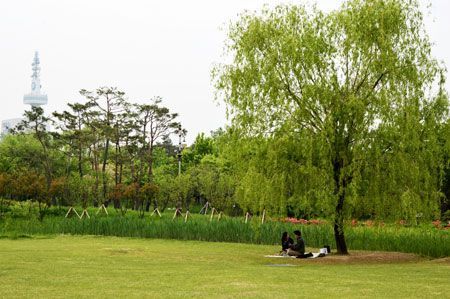
A couple rests beneath the shade of a willow tree in the West Garden of the Hanbat Arboretum in Seo-gu, Daejeon. / Korea Times photo by Yun Suh-young
By Yun Suh-young
Daejeon is not generally regarded as a desirable travel destination. It is viewed more as a boring transit hub connecting the Seoul metropolitan area to southern parts of the country rather than a quality place in which to spend time. However, a trip to the town proves that the city has much more to offer than its reputation suggests.
Only 50 minutes away from Seoul via the KTX and just two hours by car, the town of 1.5 million is an underrated weekend destination, offering a variety of activities for fun and leisure. It’s also a great place to kick back, relax and do nothing.
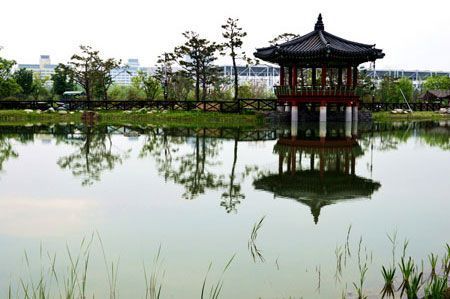
A view of the pagoda next to the lake in the East Garden of the Hanbat Arboretum in Seo-gu, Daejeon.
Refreshing
Visitors who stay a day or two in Daejeon will find that the city is incredibly relaxing and refreshing. This is mostly due to the green areas in and around the city.
On the outskirts of Daejeon, there are four major mountains — Mts. Gejok, Sikjang, Bomun, and Gubong. Mt. Gejok is a popular barefoot walking destination. The mountain, 423.6 meters high, has a 14 kilometer trekking trail, 13 kilometers of which are covered with red clay, a route that is accessible from spring to autumn.

A couple walks down the red clay path at Mt. Gejok in Daedeok, Daejeon, which is famous for its barefoot hiking path with red clay spread along it.
Trekkers are recommended to walk barefoot on the red clay simply because it feels great on the feet and is said to help relieve stress. Also a classical music concert is held every Saturday and Sunday at 4 p.m. on an outdoor stage on the hiking route from April through October.
Greenery is also an essential part of Daejeon’s urban landscape. At the center of the city lies the Hanbat Arboretum, a 387-square-meter space in the middle of a downtown district.
Divided into the West Garden and East Garden by an outdoor concert hall, the arboretum is a large-scale, well-organized outdoor garden that is beautiful to look at and an even better place to enjoy a stroll.
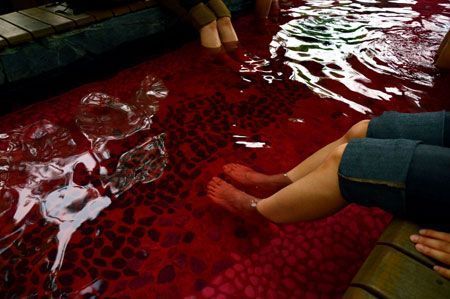
Visitors dip their feet in an outdoor foot spa, which is a smaller hot spring pool at the Yuseong Hot Spring in Yuseong, Daejeon.
The West Garden, which opened in 2005, begins with a huge grass park with a willow tree that reminds visitors of romantic movies, especially when a couple enjoys a date beneath the shade of the tree. The garden also consists of 15 smaller themed gardens.
On the other side of the park lies the East Garden, built in 2009, which has 19 smaller themed gardens. On the first weekend of June every year, a festival is held in the arboretum.
A Korea Forest Expo will be held starting today through May 30 at the Daejeon Expo Park right next to the arboretum.
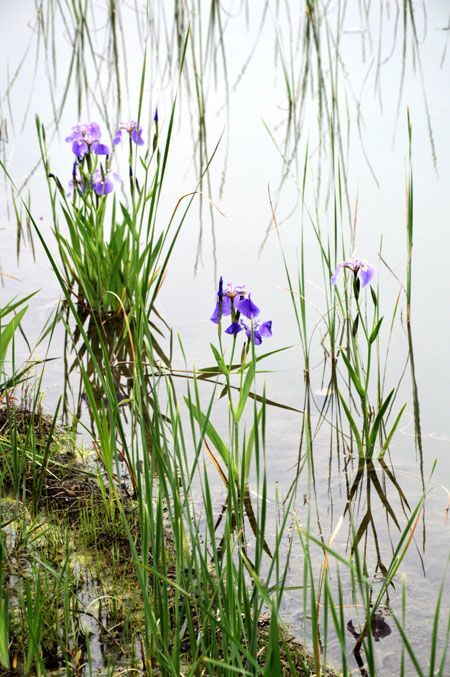
Irises blossom on the edges of Daecheong Lake along the Lohas Happy Road near Daecheong Dam in Daedeok, Daejeon. / Korea Times photos by Yun Suh-young
Relaxing
Daejeon displays cohesion between nature and state-of-the-art urban infrastructure that is rarely found in other Korean cities. And this seems to define how its people live.
The Yuseong Hot Spring has long been a favorite place for Daejeon residents to relax, averaging 500 visitors on weekdays and double that on weekends.
The water temperature ranges from 27 to 56 degrees Celsius. The low alkaline water is smooth in texture — so soft that it feels like your feet have been lathered in soap.
It’s unclear when people began enjoying the natural hot spring, but an educated guess is that it started during the earlier part of the Joseon Kingdom (1392-1910). It is famous for a myth about a mother who cured her son’s scars by dipping him in its waters. The hot spring was converted into a modern facility in the 1920s.
Another popular facility at the hot spring is an outdoor foot spa, which includes a smaller hot spring pool for visitors to dip their feet into. The foot spa opens from 7 a.m. through 11 p.m. every day and is free of charge.
The foot spa is a great option after walking around the nearby Gapcheon River, which is flanked by a jogging track that is far better designed and built than most routes along the Han River in Seoul.
For a longer, quieter walk, the “Lohas Happy Road” around Daecheong Lake might be a better choice. The lake is the third largest in the country and a good photo spot. There is one spot beside the lake that is particularly great for photos; a mystical sort of scene created by trees half-submerged in the waters.
The lake is also famous for being next to the President’s summer vacation house, Cheong Nam Dae, which is open to the public.
There are nine trails surrounding the lake — six for walking and three for cycling. The trekking trails are fairly flat so visitors can just stroll along them.
Enriching
Although fairly neglected in terms of cultural events, Daejeon still has a couple of great cultural venues to visit. The Daejeon Culture and Arts Center and the Leeungno Museumlocated next to the Daejeon Expo Park are a few.
A food and wine festival will be held at the expo park from Oct. 3 through 6.
Then there’s the Ppuri Park and the Natural Heritage Center located next to each other which provides rich information about the roots of Korean surnames. At the Ppuri Park, 136 sculptures commemorate the family surnames.
This is an interesting place for Koreans to visit because they can trace back their family roots.
On the way home, don’t forget to visit Sungshimdang, a bakery with a history exceeding 60 years, where they sell the most delicious “soboro” or streusel bread. There’s one inside Daejeon Station and one near the Euneungjeongi Culture Street.