Jeju Air to offer lower fares on Incheon-Tokyo route
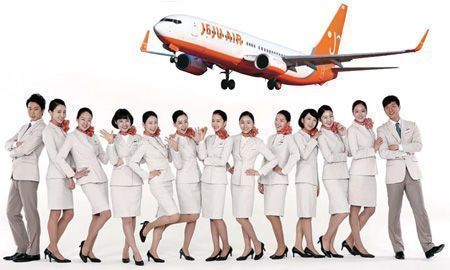
Cabin crews of Jeju Air pose at a Seoul studio in February. The low cost carrier affiliate of Aekyung Group said it will launch flights connecting Incheon and Tokyo in July to meet growing demand from customers. / Courtesy of Jeju Air
By Kim Jae-won
Jeju Air will launch flights between Incheon and Tokyo in July to meet growing demand from customers who use one of the most popular international routes here.
The low cost carrier (LCC) of Aekyung Group said the company will provide four flights on the route every day ― two from Incheon International Airport to Tokyo’s Narita International Airport and two from Narita to Incheon.
With the Incheon-Narita route, Jeju became the first LCC both in Korea and Japan to have a presence in all Japan’s four major cities ― Tokyo, Osaka, Nagoya and Fukuoka.
“The Incheon-Narita route is one of the busiest in the two countries. With this launch, customers may enjoy expanded choices in their journeys,” a Jeju official said.
Airfares for a round trip, including tax, vary from 120,000 won ($108) to 520,000 won according to the ticket type and length of stay.
That is 25 to 50 percent cheaper than its full service carrier rivals, such as Korean Air, which provide airfares on the same route for between 450,000 won and 780,000 won.
The number of passengers on the Incheon-Narita route marked 2 million in 2012, up 7.5 percent from a year earlier, according to Jeju Air, promising a bright future.
The number of passengers on the Gimpo-Haneda route, which connects the city airports of Seoul and Tokyo, also posted 2 million last year, but that was down 0.3 percent from a year earlier.
About 270,000 passengers flew Jeju Air on the two Korea-Osaka routes ― Incheon-Osaka and Gimpo-Osaka ― last year, accounting for 10.1 percent of all passengers. That is more than two times its local LCC rivals, Air Busan and Eastar Jet, which marked 4 percent and 4.2 percent of market share during the same period.
Jeju said customers are moving from full service carriers, such as Korean Air and Asiana Airlines, to LCCs as they acknowledge the efficiency of the smaller airlines.
The LCC market share of Korea-Japan routes was 13.1 percent last year, up from 7.1 percent in 2011, while that of FSCs dropped to 84.5 percent from 89.6 percent during the same period.