N. Korea wants to resume 6-party talks
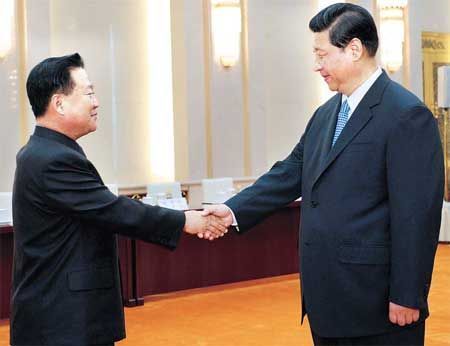
Chinese President Xi Jinping, right, shakes hands with Choe Ryong-hae, the special envoy of North Korean leader Kim Jong-un in Beijing, Friday. Choe delivered Kim’s handwritten letter to the Chinese leader. Kim said in the letter that the North is willing to resume the six-party talks on ending its nuclear programs. Xinhua-Yonhap
Kim Jong-un’s envoy meets Xi Jinping
By Kim Tae-gyu
North Korea said Friday it is willing to resume the six-party talks on ending its nuclear programs.
North Korean leader Kim Jong-un’s envoy Choe Ryong-hae met with Chinese President Xi Jinping to make the point while delivering Kim’s letter to Xi, China’s state media said.
“Based on cooperation with related countries, North Korea wants to deal with associated issues through various types of dialogues and negotiations including the six-party talks.” Xinhua News Agency quoted Choe as saying.
Choe, the director of the General Political Bureau of North Korea’s People’s Army, said the North will come up with “proactive actions to safeguard peace and stability” on the Korean Peninsula.
In response, Xi said that China’s stance is clear that it will put forth efforts to ease tensions and secure long-term peace in Northeast Asia through the six-party dialogues.
Seoul welcomed the surprise proposal.
“First of all, we welcome Pyongyang’s return to the six-party talks even though it remains to be seen whether its word will be kept,” said Kim Hyoung-zhin, presidential secretary for foreign affairs. “We will check the precise comments of Choe.
We will keep an eye on the case.” Observers point out that it will be difficult to make North Korea give up its nuclear ambitions even though the belligerent country restarts the multilateral talks that involve the United States, Japan, China and Russia in addition to the two Koreas.
“Through half a year maneuvers of generating great tensions, the North seems to think that it has achieved two major goals — prompting others to believe that Kim is a strong leader and it is a full-fledged nuclear power,” Sejong Institute analyst Paik Hak-soon said.
“The eventual target of the communist regime is to have discussions with the United States with the aim of getting the super power’s guarantee on its regime’s survival. The thinking is that the six-party talks are a good tool to do so.” However, he added that the North, which conducted its third atomic test this February resulting in stringent U.N. sanctions, would not easily give up its nuclear programs.
Choe, Kim’s confidante who arrived in Beijing Wednesday, has iterated that Pyongyang would engage in dialogue with China, before promising to restart the six-party talks.
He visited China on a fence-mending mission with its only ally and benefactor because the two countries’ relationship has been strained since the North’s nuclear test.
The six-party talks were initially designed to find a peaceful way of dealing with security concerns on the Korean Peninsula because the North’s nuclear threats have caused concern among neighboring countries.
The six countries discussed the aftermath of North Korea’s withdrawal from the Nuclear Non-Proliferation Treaty (NPT) in 2003.
Several rounds of discussions among the six countries from 2003 through 2007 produced the substantive result of making the North pledge to shut down its nuclear facilities in exchange for fuel aid and a rapid normalization of its diplomatic relations with the U.S. and Japan.
But the North pulled out of the six-party talks in early 2009.