Flower of S-N detente all but closed
Gaeseong Industrial Complex to see off last 50 S. Koreans Monday
By Chung Min-uck
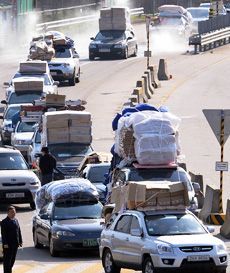
South Korean vehicles, fully loaded with goods and finished products, arrive on their trip from the Gaeseong Industrial Complex at the customs, immigration and quarantine office in Paju, Gyeonggi Province, Saturday. / Korea Times photo by Kim Joo-sung
The Gaeseong Industrial Complex, the symbol of inter-Korean detente, has been all but closed with a skeleton team of 50 personnel, the last group of South Koreans, scheduled to return home Monday.
They are responsible for utilities, water and other infrastructure facilities that have kept 123 southern firms in operation at the industrial park.
Their departure would put the factories on mothballs for the first time in the 10 years since the complex came into being in 2004 at the height of the “sunshine policy” of engaging the North.
According to the Foreign Ministry, U.S. Deputy Secretary of State William Burns told Foreign Minister Yun Byung-se his country fully supported Seoul’s decision to withdraw all personnel from the industrial park in the northern border town.
The government made no official response Sunday, following through on its decision to pull out all personnel last Friday. On Saturday, 126 workers, including one Chinese national, who were responsible for maintenance returned home to the South.
The North blamed the South for the closure but stopped short of saying it wants the Gaeseong complex closed permanently.
“The responsibility should squarely rest with the South if the complex is completely closed,” said a spokesman for the General Bureau for the Special Zone Development Guidance, in a report released by the Korean Central News Agency (KCNA) Saturday.
A total of 54,000 North Koreans were employed at the complex and paid $86 million in collective wages per year. The complex was accused of being used as aid for the North’s missile and nuclear development during the Bush administration.
The communist nation last month unilaterally severed both the emergency and military communication hotlines with South Korea in response to Seoul’s annual joint military drills with Washington.
In an announcement issued Friday after North Korea refused an offer for dialogue, Seoul said the government would pull all of its citizens from the joint manufacturing zone.
Experts, however, say the two sides still have room to maneuver to normalize the operation of the park.
As of Sunday, the government had yet to cut off electricity sent to the complex from the South Korean border city of Paju, Gyeonggi Province.
North Korea also refrained from directly mentioning an end to the project.
“As of now, the government is focusing on ensuring the safe return of the remaining 50 South Korean citizens in the complex,” said a unification ministry official, Sunday. The government is to decide whether to cut off the electricity after their return Monday, the official said.
Those remaining are largely personnel sent by KT, land developer LH, Korea Electric Power Corp. and members of the zone’s management committee, who are making last minute checks of the infrastructure facilities there.
The official also said every effort will be made to reduce the fallout from withdrawing the workers.
There have been estimates that losses incurred by businesses will reach 1 trillion won ($900 million).
Seoul is bracing to set up a special organization dedicated to assisting businesses forced to leave Gaeseong.
The businesses that pulled out of Gaeseong asked Seoul on Saturday to take all necessary measures to ensure the safety of facilities left behind and to continue to engage the North in talks for the reopening of the complex.
They also asked permission for representatives from the complex to visit the North on Tuesday so they can try to meet with North Korean officials.