Ewha University, AUW work together for educating talented women in Asia

Kim Sun-uk, left, president of Ewha Womans University, talks with Kamal Ahmed, president and CEO of the Asian University for Women at her office on the school’s campus in Seoul, March 28. / Courtesy of Ewha Womans University
By Bahk Eun-ji
Some people believe that Park Guen-hye becoming South Korea’s first female president represents significant change in society here, especially in terms of opportunities for women.
Indeed, in recent years, a number of women have gained pivotal roles in various sectors.
Those who had the opportunity to achieve this did so by receiving a good quality of education thanks to efforts from pioneering academic institutions such as Ewha Womans University.
“There’s still a long way to go before gender equality will be achieved, not only in Korea but in many other regions around the world, especially in Asia,” Ewha President Kim Sun-uk said.
“We’ve encouraged women to carry out social responsibilities by providing them with a reasonable quality of education. We’ve also tried to change the male-dominated culture across various sectors of our society, including politics, administration and finance,” she said.
As for educating women, the president also pointed out that the university is also responsible for sharing what they have achieved with other underprivileged women around the world, especially those living in less developed countries in African and Asia.
“The Asian University of Women (AUW) is cultivating talented women who are deprived of opportunities just because they are poor in Asia, just as Ewha has done. We expect that we will be a good role model, especially in terms of advocating for the human rights of women,” Kim said.
Kamal Ahmed is the president and CEO of AUW, established in Chittagong, Bangladesh, in March 2008. He has been paving a new path for women’s education in Asia, confronting the problems created by war, poverty, ethnic conflicts and discrimination.
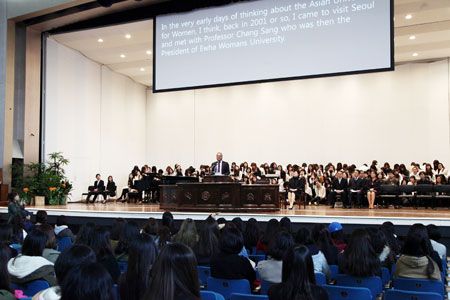
Kamal Ahmed, president and CEO of the Asian University for Women, gives a lecture at a chapel at Ewha Womans University in Seoul, March 28. / Courtesy of Ewha Womans University
Currently, almost 500 students from 13 different Asian countries, including Afghanistan, Cambodia, India, Iran, Myanmar (Burma), Pakistan and Sri Lanka are enrolled on the program of the university. Graduates usually go back to their home country to share what they learned with others.
“We’ve chosen to look at Ewha because it is one of the older and most successful institutions as well as one of the largest women’s universities in Asia,” Ahmed said.
“Although Korea is now a highly developed country, its economic and social conditions were similar to those currently in South Asia only a generation or so ago. Hence, we thought the leading women’s university in Korea would be instructive for us,” he said, explaining why AUW chose Ewha as a partner.
Ahmed grew up in Bangladesh before attending Harvard and the University of Michigan Law School. He recalled the day he visited Ewha for the first time in 2001.
“Back when I came to Seoul in 2001 to meet Prof. Chang Sang who was the president of Ewha Womans University at that time, I remember her listening to my idea patiently even though we had no organization, certainly no funds,” he said.
“And most of my own time was still bonded to my law practice, based on that one meeting, she fully supported the idea, joined the International Support Committee for the university and even came out to New York to speak at a panel with Prof. Hanna Gray, former President of the University of Chicago in support of the AUW,” the CEO said.
“She didn’t ask what a man was doing trying to set up a women’s university. She just said it was an important idea, necessary, and that we should get it done,” The CEO also noted the reason he looked to Ewha as a beacon of light that AUW could follow.
“Ewha has educated many women who became role models: The first female Cabinet member to the Korean government, the first female medical doctor, first lawyer, first apparel company president, first daily newspaper president, as former President Chang mentioned during her remark in New York, I believe in notion education as a powerful instrument of change,” Ahmed said.
He emphasized that educating young women would play a vital role in Asia where gender discrimination is still widespread despite progress in some countries.
Setting up AUW is also based on the fact that women tend to set out their skills, income or education to support the families and communities they belong to. Therefore, empowering young women is likely to benefit their societies as a whole, he said.
“The need for women’s education is apparent everywhere you look in Bangladesh. How can a country progress if half of its people are not educated and cannot participate in society effectively?” he said.
“Having grown up on a university campus, I was familiar with how universities are organized. So, it seemed that setting up a women’s university would be enormously worthwhile as well as feasible,” the CEO added.
Both Ewha and AUW have agreed on the necessity of education for women and they have decided to work together through the Ewha Global Partnership Program (EGPP). EGPP is a program for cultivating talented women from developing countries, and currently a total of 154 students from 34 countries have been attending the program.