Gates plans joint nuclear research with Korea
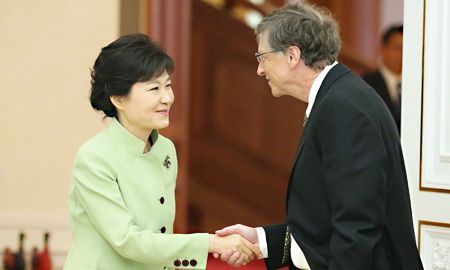
President Park Geun-hye shakes hands with Microsoft founder Bill Gates, right, before a meeting at Cheong Wa Dae, Monday. / Yonhap
By Kim Tae-gyu
Microsoft founder Bill Gates plans to start joint work with Korea on next-generation nuclear reactors, which are more cost-effective, safer and generate very little waste.
In a meeting with President Park Geun-hye, Monday, the software mogul talked about fourth-generation nuclear reactors, which are expected to become the norm in a few decades.
“Gates said he regards nuclear power as a stable energy source free of greenhouse gases although there are issues to tackle such as negative public perception, malfunctions and waste,” Park’s spokeswoman Kim Haing said.
“To address such problems, Gates asked for cooperation with Korea in the development of such reactors, which would involve computer technology.”
Gates invested $35 million in 2010 to establish Terrapower, which aims to develop sustainable and economic nuclear energy, and has sought ways of working with Korea, one of the world’s leaders in developing innovative nuclear technology.
In response, Park hoped the envisioned joint project of Terrapower and Korean firms on fourth-generation reactors will generate tangible results.
With regard to “creative economy,” one of President Park’s main goals, Gates stressed the significance of an eco-system where entrepreneurs can get over failures and venture capitalists prevail.
He also praised Korea’s active aid to underdeveloped countries, citing it as a role model that transformed from an impoverished agricultural society to an industrialized economy in a short period of time.
The remarks are in line with those Gates made earlier during a meeting with lawmakers when he asked Korea to offer “smart aid” to undeveloped nations so they will be able to replicate its success story.
Defining smart aid as intensive investments in areas that affect the most people with the most urgent needs, he encouraged Korea to adopt the concept.
“I sometimes call this approach (of making the greatest impact) smart aid, and that is having the greatest impact in saving children’s lives and helping people lift themselves out of extreme poverty,” Gates said.
“When you think about it, the greatest asset of every country is the energy and talent of its people. Disease saps that energy and squanders that talent. Healthy people build thriving economies. Freeing people from the relentless burden of sickness and death will unleash more human potential than any other revolution in history.”
He praised Korea’s efforts to take advantage of foreign aid through a variety of official programs like the Saemaeul Movement, which was initiated by former President Park Chung-hee, the late father of the incumbent President.
“The Saemaeul (New Village) Movement and other innovative government programs were critical to the modernization of Korea. Another important piece was Korea’s effective use of $13 billion in foreign assistance,” he said.
“Korea’s development experience is proof that development aid works, especially aid focused in areas such as health and agriculture. Koreans can be proud of the country’s dedication in bringing its experience and resources to bear to help other countries still struggling to overcome big challenges.”
He said he thought highly of Asia’s fourth-largest economy for its commitment to raise its official development assistance (ODA) to 0.25 percent of its gross national income (GNI).
Yet, Gates suggested Korea still has a long way to go as that rate still falls far short of the average of the Organization for Economic Cooperation and Development (OECD).
“As Korea’s economy continues to grow, my hope is that the people of this great country will embrace that opportunity, perhaps even to surpass the OECD average ODA-support level of 0.43 percent of GNI,” he said.