Do allies need to keep pressure on?

A U.S. U-2 reconnaissance aircraft is photographed while flying over Osan Air Base in Pyeongtaek, Gyeonggi Province, during the Foal Eagle exercise, Tuesday.
Some fear no letup in show of force may lead NK to more provocation
By Kang Seung-woo
There is a saying that, when cornered, a rat can turn around and bite a cat.
Finding a sense of wisdom in this, some North Korea experts say it is about time to moderate the recent show of force by the United States in joint drills with South Korea and see how Pyongyang will react.
It is obvious this show of force by the world’s largest military superpower is acting as a deterrent against the North, which has been spewing belligerent vitriol to jack up tension.
“As the North was ramping up its rhetoric and military show of force, the South and the United States needed to display their deterrence capability against its threats,” said Chang Yong-seok, a senior researcher at the Institute for Peace and Unification Studies at Seoul National University.
“But an excessive demonstration of U.S. military might unnecessarily spike the tension. We need to be cautious and control the level of show of force. We do not have to slap a crying child in the face.”
The situation is so precarious that President Park Geun-hye ordered a meeting of national security-related ministers Monday night.
Park presided over the meeting to go over the situation in detail.
The U.S. Forces Korea (USFK) was scheduled to show its F-22 Raptors to the Korean media Tuesday, but cancelled the plan a day earlier, simply saying circumstances had changed.
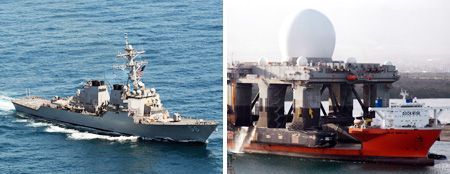
The USS John S. McCain, left, a guided missile destroyer, and the SBX-1, a sea-based radar platform, have been positioned off the South Korean coast in order to monitor North Korea’s military moves amid heightening tension on the Korean Peninsula. / Korea Times photo by Shim Hyun-chul, Yonhap
There were reports the cancellation was part of a decision not to further provoke the North, although the USFK declined to comment.
“The cancellation is not a bad decision,” Chang said.
“I think it looks like a government- or Cheong Wa Dae-level decision to defuse the current situation. It is a positive sign.”
Yang Moo-jin, a professor at the University of North Korean Studies, agreed. “Mindful of more provocation of the North with the continuous U.S. show of force, it is seen as part of efforts to calm down the situation on the Korean Peninsula.”
However, the U.S. government said there was little unusual about the recent U.S. demonstration of military power.
A string of demonstrations of U.S. advanced military capabilities started with a flyover by a nuclear-capable B-52 bomber and two B-2 stealth bombers. The USS Cheyenne, a nuclear attack submarine, also participated in the Foal Eagle exercise ― an annual joint maneuver that is scheduled to continue until April 30 ― before two F-22 stealth fighter jets highlighted the demonstration of U.S. military might, Monday.
In addition, USS John S. McCain, a guided missile destroyer, and the SBX-1, a sea-based radar platform, are positioned off the South Korean coast in order to keep a close watch on the North’s military moves, a U.S. Defense Department official told CNN on Tuesday.
“We, the United States and South Korea, have not been involved in provoking anything. We, over the years, have been engaged with South Korea on joint exercises. The B-2 flight was part of that,” U.S. Secretary of Defense Chuck Hagel told reporters at the Pentagon Friday.
One day after the B-2 flyover, the reclusive Stalinist state declared it had entered a “state of war” with the South.
White House spokesman Jay Carney also said Tuesday that the United States is taking necessary precautionary measures.
“The actions we’ve taken are prudent, and they include, on missile defense, to enhance both the homeland and allied security, and other actions like the B-2 and B-52 flights, have been important steps to reassure our allies, demonstrate our resolve to the North,” he said at a briefing.
“We believe this has reduced the chance of miscalculation and provocation.”
He added that there is no sign of any unusual military action by North Korea despite its near-daily threats to attack the United States and its regional allies.