Park coordinates with US on NK
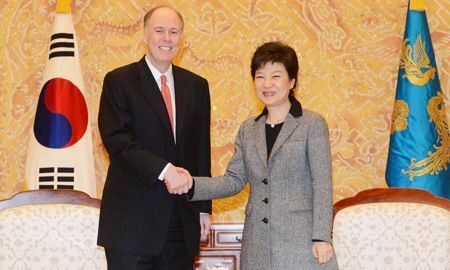
President Park Geun-hye shakes hands with Thomas Donilon, U.S. President Barack Obama’s national security advisor, at Cheong Wa Dae in Seoul, Tuesday. / Yonhap
By Kim Tae-gyu
President Park Geun-hye said Monday that South Korea will closely cooperate with the United States to sternly respond to any provocations by North Korea, including nuclear tests.
In a meeting with U.S. envoys, Park stressed that the close collaboration between the two long-time allies is crucial in coping with the threat posed by Pyongyang after it carried out a third nuclear test on Feb. 12.
The strong remarks came just one day after Park issued a stern warning against the North’s continued pursuit of its atomic weapons program during her inaugural speech.
“North Korea’s nuclear armament can never be accepted and the international community should respond sternly to provocations by North Korea, led by the alliance of Seoul and Washington,” a Cheong Wa Dae official quoted Park as telling the American entourage headed by U.S. President Barack Obama’s national security advisor, Thomas Donilon.
Donilon, a close aide of Obama, agreed saying that the two nations are required to join forces not only in tackling the nuclear crisis but also in dealing with other North Korea issues across the board.
However, Park did not stick to just a hard-line stance as she explained her ideas on how to build stability in Northeast Asia, the backbone of her flagship policy called the “Korea Peninsula Trust Process,” under which she promised a more flexible approach to the North.
The presidential office said that Park’s reasoning resonated with Donilon, who suggested closer consultations with other countries in the region.
Donilon also asked Park to visit the United States “as soon as possible,” a request positively responded to by Park.
The President was flanked by new aides including Ju Chul-ki, her senior presidential secretary for foreign affairs and national security, and Cho Won-dong, her senior economic secretary.
On the U.S. side were Daniel Russel, director for Japan, South Korea and North Korea at the White House National Security Council; Ambassador to Korea Sung Kim; and Gen. James Thurman, commander of the ROK-U.S. Combined Forces Command.
Donilon is one of many delegates from 19 countries Park has met since her inauguration Monday.
On Tuesday morning, Park met Canada’s Governor General David Johnston and extended her gratitude for the country’s opposition to the North’s nuclear test.
Johnston expressed Canada’s hopes to strengthen bilateral ties with Korea by signing a free trade agreement and beefing up educational cooperation.
Among other visitors received by Park were U.N. Deputy Secretary-General Jan Eliasson, Indonesian Vice President Boediono, Peruvian Vice President Marisol Espinoza, Vietnamese Vice President Nguyen Thi Doan and Australia’s Governor General Quentin Bryce.
On Monday, Park had separate meetings with China’s Liu Yandong, the highest-ranked female in its Communist Party, and Russia’s Ishaev Victor, the minister for development of the Far East.
She also met with a Japanese delegation headed by Deputy Prime Minister Taro Aso. Park expressed her regrets that the two country’s relationship is suffering due to disputes over history distortion.
The bone of contention has been Korea’s easternmost islets Dokdo over which Japan has repeatedly claimed sovereignty.
Last week, a host of senior Japanese officials and politicians attended Japan’s annual event aimed at claiming Dokdo, which generated protests from Seoul.