Call mounting for withdrawl of Lee Dong-heub nomination
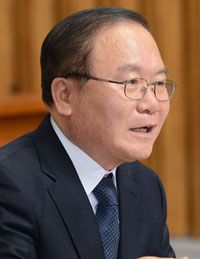
Lee Dong-heub
By Jun Ji-hye
The Democratic United Party (DUP) called for President Lee Myung-bak and President-elect Park Geun-hye to act swiftly to withdraw the nomination of Lee Dong-heub as Constitutional Court president.
DUP floor leader Park Ki-choon said at a session of the National Assembly, Tuesday, that: “Cheong Wa Dae, the President-elect and the ruling party are shifting the responsibilities onto others, though over 60 percent of the public are against the nomination and even some Saenuri Party members have called for Lee to step down voluntarily.”
He said the unsettled question for now is who will take responsibility and withdraw the nomination, adding that it is absurd to leave the leadership vacuum at the top court.
The call came as the ruling Saenuri Party’s said there should be a National Assembly vote on the matter.
A day earlier, Saenuri Party Chairman Rep. Hwang Woo-yea said, “If the discussions have ended, each lawmaker needs to be guaranteed to exercise their right to vote.”
Lee Jung-hyun, in charge of political affairs of Park’s transition team, echoed Hwang’s view saying, “It is abnormal to force Lee to step down having been nominated.”
Such comments have caused new controversy as it appears the ruling party’s leader is pressuring the parliament’s speaker to put forward a confirmation vote at the plenary session.
The DUP floor leader claimed, “Bringing the bill to the plenary session with the speaker’s authority is the only way to vote on it. The ruling party finally expressed its true intention to ram through the bill.”
The nominee is suspected of embezzling of 320 million won ($294,000) in public money while serving as a justice at the top court from 2006 to 2012. He is also suspected of tax evasion when purchasing an apartment in Bundang in 1992.
As the National Assembly’s committee failed to reach an agreement to send the bill to a vote two weeks ago, three possibilities remain.
President Lee, who has appointive powers, can withdraw the nomination or the parliament’s speaker can send the bill to a vote with his authority. The other option is Lee’s voluntary withdrawal.
Although Lee was officially nominated by the President, Park and her incoming government are believed to have tacitly agreed on the nomination as, if approved, the nominee would work during Park’s time in office.
Considering this, Rep. Park added Hwang, who also had expressed his skepticism on Lee, will have to clarify whether or not the President-elect agreed on such a vote.
Rep. Kim Sung-tae of the Saenuri Party, who also strongly opposed the nomination, agreed in part with the opposition leader.
“It is inappropriate that the speaker uses his authority to push forward the vote regarding Lee, whose appointment motion wasn’t passed. It would be more sensible for him to voluntarily step down,” he said Monday in an appearance on CBS radio.
Regarding the issue, the presidential office has said Cheong Wa Dae already took relevant steps to nominate Lee and now the matter lies in the hands of the National Assembly.
Although many observers raised the possibility that Lee may voluntarily drop his bid to become the court’s head in the face of mounting criticism, he has kept silent for two weeks since failing to pass the confirmation process.
The 60-year-old President-elect and her team haven’t expressed their stance on the matter.
The opposition party has criticized Lee regarding his alleged pro-Japanese attitude as well, saying he took Japan’s side when dealing with the issue of wartime sex slavery.
Critics also claim that Lee said the nation should not confiscate property from descendants of pro-Japanese traitors who acquired their assets during the Japanese colonial era.