Perjury penalty needed for confirmation hearing

Activists urges Lee Dong-heub, nominee for president of the Constitutional Court, to bow out during a confirmation hearing near the front gate of the National Assembly, Seoul, last Tuesday. / Yonhap
Constitutional Court chief nominee shows plenty of flaws in selection process
By Kang Hyun-kyung
Lee Dong-heub, President Lee Myung-bak’s nominee for president of the Constitutional Court, put ethics behind ambition and this drove him to blur the line between dos and don’ts while serving as a justice for six years.
Now, his greedy past seems to have caught up with him as his flawed ethics are starting to ruin his career. The parliamentary stalemate on Lee Dong-heub’’s confirmation hearing even saw some ruling party lawmakers, not to mention the opposition, skeptical about him.
Rep. Seo Gi-ho of the minor opposition Progressive Justice Party told The Korea Times that coupled with Lee’s politically-driven personality, systematic loopholes are also responsible for “the nomination malfunction.”
Seo, one of the 13 members on the confirmation hearing committee, said he thought it would be easy to make the corruption-riddled Lee drop out of consideration because he held several “decisive cards.”
The judge-turned-lawmaker said he has 14 or 15 pieces of evidence that support the conclusion that the nominee was the wrong choice for the crucial job.
Despite this, Seo, 43, confessed that he struggled during the two-day hearing last Monday and Tuesday when he tried to corner Lee because the nominee kept trying to cover up allegations or justify his acts.
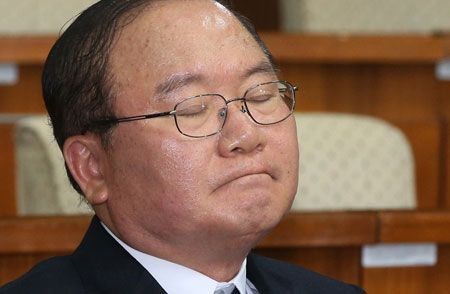
Lee Dong-heub, President Lee Myung-bak’s nominee for president of the Constitutional Court, looks pensive during a confirmation hearing at the National Assembly on Jan. 21. / Yonhap
“Lee even lied four or five times during the hearing,” Seo said.
The lawmaker lamented that under the current law, no disciplinary measures are in place to punish nominees making false statements at a confirmation hearing.
Coming under mounting pressure from lawmakers to submit documents to verify some of his claims, Lee resorted to delaying tactics, irritating members of the committee
Seo’s patience wore thin as Lee remained unwilling to cooperate with lawmakers when they asked whether information they had on the nominee was true or not.
“When I contacted my former colleagues, judges who are still working with the courts, to check what kind of reputation Lee had among them, they were deeply troubled. They said the nomination of Lee as head of the top court was a worst-case scenario,” Seo said.
“I was also told that many judges found it tricky to work with Lee as their boss because he was authoritative, politically motivated and did anything necessary to serve his vested interests.”
Seo suspects that Lee may have used his job as a Constitutional Court justice to make his dream -- becoming head of the court -- come true.
“While serving as a justice, he presented plenty of dissenting opinions on major rulings, as I think he tried to side with the ruling Saenuri Party (as his opinions were in line with that of the ruling party),” he said. “Justices are expected to present their own, independent opinions based on their conscience and sound judgment when the court rules on a particular case. Lee was rare in that he presented too many dissenting opinions and I think this was driven by his personal ambition to be nominated as head of the top court later.”
Privacy controversy
During the confirmation hearing, Lee was grilled over a number of allegations. That he committed acts of plagiarism, misused taxpayer’s money for his and his family’s wellbeing, and embezzlement as well as facilitating tax evasion by his son.
Since the confirmation hearing was first adopted in 2000 under the Kim Dae-jung government, nominees for key public office have been attacked for diverse allegations. Some of them withdrew themselves for consideration after failing to weather mounting pressure to step down.
The flare-up of fresh allegations at the hearing is partly the result of lawmakers’ research into nominees’ past tax records, reputation and careers.
In the past, some highly-qualified candidates reportedly rejected an incumbent president’s call to assume Cabinet posts because they considered the thorough screening as a high-stakes poker game that could ruin their future.
In 2010, it took considerable time for President Lee Myung-bak to nominate a new prime minister after Chung Un-chan stepped down. The sitting president reportedly had a hard time in his selection partly because the confirmation hearing discouraged some potential candidates from accepting Lee’s call.
Critics say lawmakers often go too far under the name of scrutinizing potential public figures to the extent of sometimes violating their privacy.
Despite the privacy controversy, advocates say a thorough screening of key would-be public officials is imperative simply because the consequences for the nation of flawed figures in top posts are immense.
Meanwhile, some alleged that Lee is one of the worst nominees because he remains unrepentant regarding corruption allegations brought against him without making any attempt to offer any explanation.
The 13 hearing committee members were divided over whether they should give the green light to Lee to become president of the Constitutional Court. Five of them said he should assume the post, despite his flawed ethics, six opposed his nomination while two were undecided.
The divided committee has made it impossible to reach a consensus on the candidate, which also makes it difficult for the National Assembly speaker to table the motion in the plenary session so that lawmakers can vote on it.
Nobody blows whistles
Amid the parliamentary stalemate on the nomination, questions have remained unanswered.
What made it possible for such an ethically-flawed person to rise to the post of Constitutional Court justice, which according to Seo is a position that judges strive for?
Why did no body blow the whistle on him? These questions have been raised because court staff or judges may have known about Lee’s claimed illicit activities and misuses of taxpayer’s money to serve his own interests.
Lee took nine business trips abroad while serving as a Constitutional Court justice. His wife accompanied him on visits to Europe and North America five times and sometimes the couple stayed longer than deemed necessary. These trips were paid for with taxpayers’ money.
He is also under fire for personal use of a budget given to justices for work-related activities, which some lawmakers argue would constitute embezzlement.
Seo said Lee’s abuse of power was possible because the Constitutional Court is a powerful entity that is not monitored by any external institution.
“The Board of Audit and Inspection conducts investigations into Cabinet ministries. But the agency is not entitled to look into the judicial body. The judicial body gained independence because it was necessary to protect judges from political influence,” he said.
“The rationale is that those who rise to such a high post in the court are mature enough to check their ethics was also behind the discretion that judges are given.”
Instead of investigations by the state audit agency, the court conducts internal investigations when allegations are raised.
He said the only institution that can monitor the court and its judges is the legislature.
The National Assembly conducts annual inspection into Cabinet ministries, state-run firms and the court is not an exception.
The lawmaker said he felt the need to tighten rules regarding nominees for public office as the current system has loopholes.
“The nominee is suspected of receiving fake donation receipts from a temple, which he used when he filed his tax return for a larger tax reduction. He also submitted only some of his bank account details as the current rule on asset registration of high-ranking government officials was not clear (and this has made it difficult for lawmakers to track his assets),” he said.
.jpg)
Who is Seo Gi-ho?
Rep. Seo Gi-ho, 43, of the minor opposition Progressive Justice Party is a judge-turned-lawmaker.
Born in the southwestern port city of Mokpo, South Jeolla Province, he served as a judge at courts on Jeju Island, Incheon and Seoul for 12 years after passing the state bar exam in 1997.
His life changed in February 2010 when the Supreme Court informed Seo that he had failed to pass a test to continue his job at the court.
This was followed by a controversial Twitter post in which he ridiculed President Lee Myung-bak, using the expression of “Big Taffy for Mr. President.”
The term “big taffy” is a slang in Korea to blame people for misjudgments or unpleasant behavior.
Seo joined the National Assembly after being elected as a lawmaker through the proportional representation system in the April 2012 general election.